Ch. 16 - Reactions of Aldehydes and Ketones • More Reactions of Carboxylic Acid Derivatives
Bruice - Organic Chemistry 8th Edition
Bruice8th EditionOrganic ChemistryISBN: 9780135213711Non è quello che usi tu?Cambia libro di testo
Capitolo 16, Problema 37

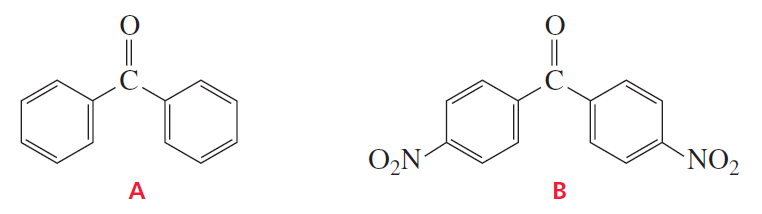
Which ketone forms the most hydrate in an aqueous solution?
Chemical structures of two ketones labeled A and B, highlighting their functional groups for comparison in hydration.

Guida verificata passo dopo passo
1
Step 1: Understand the concept of hydrate formation. Hydrate formation occurs when a ketone reacts with water to form a geminal diol. The extent of hydrate formation depends on the electronic and steric effects of substituents attached to the ketone.
Step 2: Analyze the structures of ketones A and B. Ketone A has two electron-withdrawing nitro groups (-NO2) attached to the ring, while ketone B has two alkyl groups attached to the ring.
Step 3: Consider the effect of electron-withdrawing groups. Electron-withdrawing groups like -NO2 increase the electrophilicity of the carbonyl carbon, making it more reactive toward water and favoring hydrate formation.
Step 4: Compare steric effects. Ketone B has alkyl groups, which are bulkier and can hinder the approach of water to the carbonyl carbon, reducing the likelihood of hydrate formation.
Step 5: Conclude that ketone A, with its electron-withdrawing nitro groups, forms the most hydrate in an aqueous solution due to increased electrophilicity and reduced steric hindrance compared to ketone B.

Risposta video verificata per un problema simile:

Questa soluzione video è stata consigliata dai nostri tutor come utile per risolvere questo problema.
Durata del video:
2m

Concetti chiave

Ecco i concetti essenziali che devi comprendere per rispondere correttamente alla domanda.

Hydration of Ketones

Hydration of ketones refers to the reaction where a ketone reacts with water to form a hydrate, which is a geminal diol. The extent of hydration depends on the stability of the resulting hydrate and the steric and electronic effects of substituents on the ketone. More stable hydrates are favored in aqueous solutions.
Video consigliato:
09:11
Alkyne Hydration

Electronic Effects

Electronic effects, such as inductive and resonance effects, influence the reactivity of ketones. Electron-withdrawing groups, like nitro groups, can stabilize the positive charge that develops during the formation of the hydrate, thus enhancing the hydration process. Understanding these effects is crucial for predicting which ketone will form more hydrate.
Video consigliato:
04:29
Activity and Directing Effects

Steric Hindrance

Steric hindrance refers to the repulsion between bulky groups that can impede reactions. In the context of ketones, if a ketone has large substituents near the carbonyl group, it may hinder the approach of water molecules, reducing the formation of the hydrate. Evaluating steric factors is essential for determining the most reactive ketone in hydration.
Video consigliato:
02:53
Understanding steric effects.