Ch. 14 The Autonomic Nervous System and Homeostasis
Amerman- Human Anatomy & Physiology 3e
Amerman3rd EditionHuman Anatomy & PhysiologyISBN: 9780138247201, 9780138247928, 9780138201814Non è quello che usi tu?Cambia libro di testo
Capitolo 14, Problema L3.1

The poison curare (kyoo-RAH-ray) blocks the binding of acetylcholine to its receptors at the neuromuscular junction. What effects would you predict from such a poison? Can you think of any useful applications for it? Why might an overdose of it be lethal?

Guida verificata passo dopo passo
1
Understand the role of acetylcholine (ACh) at the neuromuscular junction: Acetylcholine is a neurotransmitter that binds to receptors on the muscle cell membrane (sarcolemma) to initiate muscle contraction. Blocking this binding prevents the muscle from receiving the signal to contract.
Predict the effects of curare: Since curare blocks ACh from binding to its receptors, it would lead to muscle paralysis. This is because the muscle fibers cannot depolarize and initiate contraction without the ACh-receptor interaction.
Consider potential applications: Curare or similar compounds can be used in controlled medical settings as muscle relaxants during surgeries to prevent involuntary muscle movements. This is particularly useful in procedures requiring complete muscle relaxation.
Explain why an overdose could be lethal: An overdose of curare could paralyze critical muscles, such as the diaphragm and intercostal muscles, which are essential for breathing. Without the ability to contract these muscles, respiratory failure would occur, leading to death if not treated promptly.
Discuss possible treatments for overdose: In cases of curare poisoning, treatments may include mechanical ventilation to support breathing and the administration of acetylcholinesterase inhibitors, which increase the concentration of acetylcholine in the synaptic cleft to compete with curare for receptor binding.

Risposta video verificata per un problema simile:

Questa soluzione video è stata consigliata dai nostri tutor come utile per risolvere questo problema.

Concetti chiave

Ecco i concetti essenziali che devi comprendere per rispondere correttamente alla domanda.

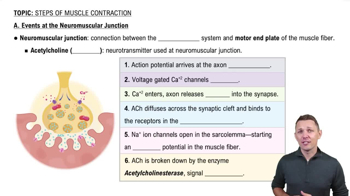
Neuromuscular Junction

The neuromuscular junction is the synapse or connection point between a motor neuron and a muscle fiber. It is where the transmission of signals occurs, allowing muscles to contract. Acetylcholine, a neurotransmitter, is released from the motor neuron and binds to receptors on the muscle fiber, triggering muscle contraction. Understanding this process is crucial for predicting the effects of curare.
Video consigliato:
5:56
A. Events at the Neuromuscular Junction

Acetylcholine Receptors

Acetylcholine receptors are specialized proteins located on the surface of muscle cells that bind acetylcholine. When acetylcholine binds to these receptors, it initiates a series of events leading to muscle contraction. Curare's action of blocking these receptors prevents muscle contraction, leading to paralysis. This concept is essential for understanding the physiological effects of curare.
Video consigliato:
2:47
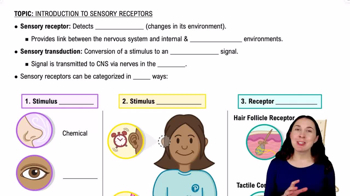
Sensory Receptors

Toxicology and Lethality

Toxicology is the study of the adverse effects of substances on living organisms. An overdose of curare can be lethal because it causes paralysis of the respiratory muscles, leading to respiratory failure. Without the ability to breathe, the body cannot obtain oxygen, resulting in death. This highlights the importance of dosage and the potential dangers of neurotoxic substances.
Video consigliato:
7:55
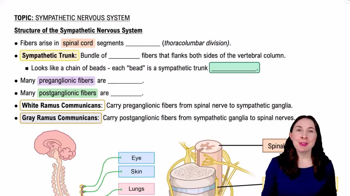
Structure of the Sympathetic Nervous System
Pratica correlata
Domanda del libro di testo

Which neurotransmitter(s) is/are used by sympathetic postganglionic neurons?


a. Epinephrine

b. Norepinephrine

c. Acetylcholine

d. Both a and b

e. All of the above

773
views

Domanda del libro di testo

Many chemical warfare agents, such as the poisonous gas sarin, block the enzyme acetylcholinesterase in the synaptic cleft. What effects will this poison have on muscle contraction? What effects will it have on the autonomic nervous system? What symptoms would you expect to see from this poison?

642
views
Domanda del libro di testo

Which cranial nerves would be affected by a drug that stimulates the parasympathetic nervous system? Predict potential adverse effects that one might experience.

631
views
Domanda del libro di testo

A patient, Dr. Young, has both asthma and high blood pressure. Her physician prescribed the drug propranolol to treat her hypertension; this drug blocks all types of β-adrenergic receptors. She also takes the drug albuterol for asthma, which activates β2 receptors on bronchial smooth muscle. Will the pairing of these two drugs cause problems for Dr. Young? Explain.

642
views
Domanda del libro di testo

Mr. Chevalier has been diagnosed with Horner syndrome, which is caused by dysfunction of the sympathetic neurons in the superior cervical ganglion that innervate structures of the head, face, and neck. What symptoms is Mr. Chevalier likely to face due to his disease? Explain.

767
views
Domanda del libro di testo

Differentiate between adrenergic and cholinergic receptors.

2149
views