Ch. 2 The Chemistry of Life
Amerman- Human Anatomy & Physiology 3e
Amerman3rd EditionHuman Anatomy & PhysiologyISBN: 9780138247201, 9780138247928, 9780138201814Non è quello che usi tu?Cambia libro di testo
Capitolo 2, Problema L2.2

Considering that water is a main component of the juices in the stomach and intestines, explain why digestion of lipids is more complicated than digestion of carbohydrates and proteins.

Guida verificata passo dopo passo
1
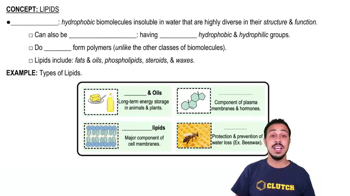
Understand the chemical nature of lipids: Lipids are hydrophobic (water-insoluble) molecules, meaning they do not dissolve in water. In contrast, carbohydrates and proteins are hydrophilic (water-soluble) and can easily mix with the aqueous environment of the digestive system.
Recognize the role of water in digestion: The digestive enzymes that break down macromolecules, such as amylase for carbohydrates and proteases for proteins, function in the water-based environment of the stomach and intestines. These enzymes can directly interact with carbohydrates and proteins because they are water-soluble.
Explain the challenge with lipids: Since lipids are hydrophobic, they tend to aggregate into large droplets in the aqueous environment of the digestive system. This reduces the surface area available for lipase enzymes (which digest lipids) to act upon, making lipid digestion more complicated.
Describe the role of bile: To overcome this challenge, the liver produces bile, which is stored in the gallbladder and released into the small intestine. Bile contains bile salts, which act as emulsifiers. These emulsifiers break down large lipid droplets into smaller droplets, increasing the surface area for lipase enzymes to work effectively.
Summarize the process: Once the lipids are emulsified, pancreatic lipase can hydrolyze triglycerides into monoglycerides and free fatty acids. These smaller molecules can then be absorbed by the intestinal cells, where they are reassembled into triglycerides and packaged into chylomicrons for transport in the lymphatic system.

Risposta video verificata per un problema simile:

Questa soluzione video è stata consigliata dai nostri tutor come utile per risolvere questo problema.

Concetti chiave

Ecco i concetti essenziali che devi comprendere per rispondere correttamente alla domanda.

Digestion of Lipids

The digestion of lipids involves breaking down fats into fatty acids and glycerol, which requires the action of bile salts and specific enzymes like lipases. Unlike carbohydrates and proteins, lipids are hydrophobic and do not dissolve in water, making their emulsification and subsequent enzymatic action more complex.
Video consigliato:

Emulsification

Emulsification is the process by which large fat globules are broken down into smaller droplets, increasing the surface area for enzymes to act. This process is crucial for lipid digestion and is facilitated by bile salts produced in the liver, which help to mix fats with the aqueous environment of the digestive tract.

Absorption Mechanisms

The absorption of digested nutrients varies among macromolecules. Carbohydrates and proteins are absorbed directly into the bloodstream through the intestinal lining, while lipids are first reassembled into triglycerides and packaged into chylomicrons, which then enter the lymphatic system before reaching the bloodstream, adding complexity to their absorption.
Video consigliato:
3:02
Internal Regulation - The Myogenic Mechanism