Considering that water is a main component of the juices in the stomach and intestines, explain why digestion of lipids is more complicated than digestion of carbohydrates and proteins.
Ch. 2 The Chemistry of Life
Amerman3rd EditionHuman Anatomy & PhysiologyISBN: 9780138247201, 9780138247928, 9780138201814Non è quello che usi tu?Cambia libro di testo
Capitolo 2, Problema 1d
Mark the following statements as true or false. If a statement is false, correct it to make a true statement.
Every element has a characteristic number of protons, which is called the element's mass number.
Guida verificata passo dopo passo1
Step 1: Understand the terminology in the statement. The 'mass number' refers to the total number of protons and neutrons in the nucleus of an atom, not just the number of protons. The number of protons in an element is called the 'atomic number.'
Step 2: Analyze the statement. It claims that the characteristic number of protons in an element is called the 'mass number.' This is incorrect because the characteristic number of protons is actually the 'atomic number.'
Step 3: Correct the false statement. The corrected statement should read: 'Every element has a characteristic number of protons, which is called the element's atomic number.'
Step 4: Review the corrected statement to ensure it aligns with the definitions of atomic number and mass number in chemistry and physiology.
Step 5: Conclude that the original statement is false and provide the corrected version for clarity.

Risposta video verificata per un problema simile:
Questa soluzione video è stata consigliata dai nostri tutor come utile per risolvere questo problema.
Concetti chiave
Ecco i concetti essenziali che devi comprendere per rispondere correttamente alla domanda.
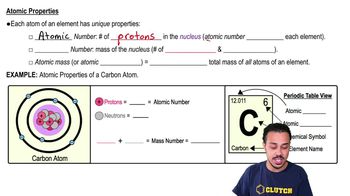
Atomic Number
The atomic number of an element is the number of protons found in the nucleus of its atoms. This number uniquely identifies an element and determines its position on the periodic table. For example, hydrogen has an atomic number of 1, meaning it has one proton.
Video consigliato:
Percorso guidato
Atomic Properties
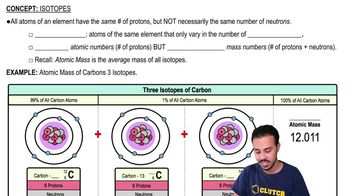
Mass Number
The mass number of an element is the total number of protons and neutrons in the nucleus of an atom. It is not the same as the atomic number, which only counts protons. For instance, carbon has an atomic number of 6 and a mass number of 12, indicating it has 6 neutrons.
Video consigliato:
Percorso guidato
Isotopes
Element Identification
Elements are identified by their atomic number, which is fundamental in chemistry. The mass number, while important for understanding isotopes, does not define the element itself. Therefore, the statement in the question is false; the correct statement is that every element has a characteristic number of protons, which is called the element's atomic number.
Video consigliato:
Percorso guidato
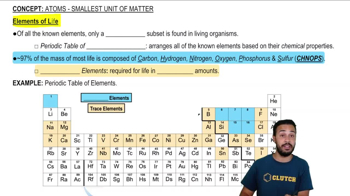
Elements of Life
Pratica correlata
Domanda del libro di testo
675
views
Domanda del libro di testo
Mark the following statements as true or false. If a statement is false, correct it to make a true statement.
Valence electrons are the electrons in the outermost shell of an atom.
677
views
1
rank
Domanda del libro di testo
Isotopes are atoms with the same ______ number but different ______ numbers.
961
views
Domanda del libro di testo
Mark the following statements as true or false. If a statement is false, correct it to make a true statement.
The mass number of an atom is the sum of its neutrons and protons.
792
views
Domanda del libro di testo
Mark the following statements as true or false. If a statement is false, correct it to make a true statement.
Protons and neutrons have a positive charge and electrons have a negative charge.
764
views
Domanda del libro di testo
Explain why monosaccharides are polar and fatty acids are nonpolar even though they both contain the same atoms.
1243
views