Ch. 2 The Chemistry of Life
Amerman- Human Anatomy & Physiology 3e
Amerman3rd EditionHuman Anatomy & PhysiologyISBN: 9780138247201, 9780138247928, 9780138201814Non è quello che usi tu?Cambia libro di testo
Capitolo 2, Problema 4

Explain the difference between an ionic and a covalent bond.

Guida verificata passo dopo passo
1
Understand that chemical bonds are interactions between atoms that allow them to form molecules or compounds. The two main types of bonds are ionic and covalent.
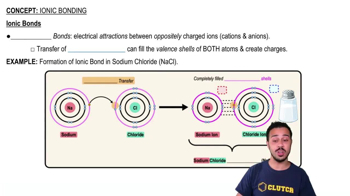
Learn that an ionic bond occurs when one atom transfers electrons to another atom, resulting in the formation of charged particles called ions. The atom that loses electrons becomes a positively charged ion (cation), while the atom that gains electrons becomes a negatively charged ion (anion).
Recognize that ionic bonds are typically formed between metals and nonmetals. For example, sodium (Na) and chlorine (Cl) form an ionic bond to create sodium chloride (NaCl). The electrostatic attraction between the oppositely charged ions holds them together.
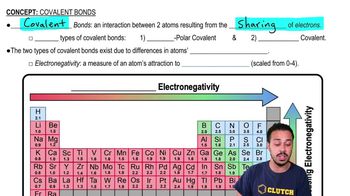
Understand that a covalent bond occurs when two atoms share electrons to achieve a stable electron configuration. This type of bond typically forms between nonmetals. For example, two hydrogen atoms (H) share electrons to form a molecule of hydrogen gas (H₂).
Compare the two types of bonds: Ionic bonds involve the transfer of electrons and the formation of ions, while covalent bonds involve the sharing of electrons. Ionic bonds tend to form crystalline structures and are often soluble in water, whereas covalent bonds form molecules and may not dissolve in water as easily.

Risposta video verificata per un problema simile:

Questa soluzione video è stata consigliata dai nostri tutor come utile per risolvere questo problema.

Concetti chiave

Ecco i concetti essenziali che devi comprendere per rispondere correttamente alla domanda.

Ionic Bond

An ionic bond is a type of chemical bond formed through the electrostatic attraction between oppositely charged ions. This occurs when one atom donates an electron to another, resulting in the formation of a positively charged cation and a negatively charged anion. Ionic bonds typically form between metals and nonmetals, leading to the creation of ionic compounds, which often have high melting and boiling points.
Video consigliato:

Covalent Bond

A covalent bond is formed when two atoms share one or more pairs of electrons, allowing each atom to attain a stable electron configuration. This type of bond usually occurs between nonmetals and can result in the formation of molecules. Covalent bonds can be single, double, or triple, depending on the number of shared electron pairs, and they generally have lower melting and boiling points compared to ionic bonds.
Video consigliato:

Electronegativity

Electronegativity is a measure of an atom's ability to attract and hold onto electrons in a chemical bond. It plays a crucial role in determining the type of bond that will form between two atoms. In ionic bonds, there is a significant difference in electronegativity between the two atoms, leading to electron transfer, while in covalent bonds, the electronegativity values are similar, resulting in electron sharing.
Video consigliato:
Pratica correlata
Domanda del libro di testo

Identify each of the following molecules or compounds as ionic, polar covalent, or nonpolar covalent.

a. H2O _________

b. LiI _________

c. C10H22 _________

d. N2 _________

e. MgBr2 _________

f. H2S _________

833
views

Domanda del libro di testo

The drug methotrexate is used to treat several different types of cancer and diseases of the immune system. It works by inhibiting an enzyme in the cell necessary for folic acid synthesis. Without folic acid, the cell cannot make nucleotides. What, specifically, does an enzyme do in the cell? Why would inhibiting this enzyme disrupt folic acid synthesis? What effect would a disruption in folic acid synthesis have on the cell as a whole? (Hint: Think about the role that folic acid plays in the cell.) (Connects to Chapter 2)

799
views
Domanda del libro di testo

Many drugs and poisons exert their effects by blocking one or more enzymes. How could blocking an enzyme lead to the death of a cell?

1054
views
Domanda del libro di testo

The polysaccharide cellulose is not digestible by humans, as we lack the enzyme cellulase, which is required to break it down. Certain dietary supplements contain the enzyme cellulase and claim that being able to break down cellulose will help a person lose weight. But what do you think would happen if we could digest the cellulose we ate?

1007
views
Domanda del libro di testo

What are hydrogen bonds, and how do they form?

1479
views
Domanda del libro di testo

Describe what takes place during a chemical reaction.

854
views
1
rank