
Ch. 22 The Digestive System
Amerman- Human Anatomy & Physiology 3e
Amerman3rd EditionHuman Anatomy & PhysiologyISBN: 9780138247201, 9780138247928, 9780138201814Non è quello che usi tu?Cambia libro di testo
Capitolo 22, Problema 5

The primary hormone that triggers the secretion of pancreatic juice and bile is:
a. Gastric inhibitory peptide
b. Cholecystokinin
c. Motilin
d. Somatostatin

Guida verificata passo dopo passo
1
Understand the role of pancreatic juice and bile in digestion. Pancreatic juice contains enzymes that help break down carbohydrates, proteins, and fats, while bile aids in the emulsification of fats.
Review the functions of the listed hormones: Gastric inhibitory peptide (GIP) primarily inhibits gastric motility and secretion, cholecystokinin (CCK) stimulates the release of bile and pancreatic enzymes, motilin regulates gastrointestinal motility, and somatostatin inhibits the secretion of various hormones and digestive enzymes.
Focus on the hormone that directly stimulates the secretion of pancreatic juice and bile. Cholecystokinin (CCK) is released in response to the presence of fats and proteins in the small intestine and triggers the gallbladder to release bile and the pancreas to secrete digestive enzymes.
Eliminate the incorrect options based on their primary functions: Gastric inhibitory peptide (a) does not stimulate bile or pancreatic juice secretion, motilin (c) is involved in motility rather than secretion, and somatostatin (d) inhibits secretion rather than stimulating it.
Conclude that the correct answer is the hormone responsible for stimulating both bile and pancreatic juice secretion, which is cholecystokinin (b).

Risposta video verificata per un problema simile:

Questa soluzione video è stata consigliata dai nostri tutor come utile per risolvere questo problema.

Concetti chiave

Ecco i concetti essenziali che devi comprendere per rispondere correttamente alla domanda.

Cholecystokinin (CCK)

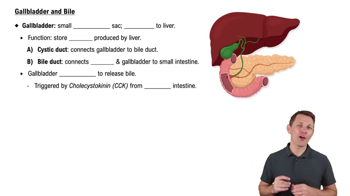
Cholecystokinin is a peptide hormone produced by the cells in the duodenum in response to the presence of fats and proteins. It plays a crucial role in digestion by stimulating the gallbladder to contract and release bile, as well as prompting the pancreas to secrete digestive enzymes. Understanding CCK is essential for recognizing its function in the digestive process.
Video consigliato:
6:54
Gallbladder and Bile

Pancreatic Juice

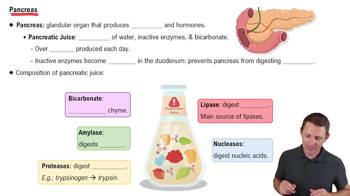
Pancreatic juice is a digestive fluid produced by the pancreas that contains enzymes such as amylase, lipase, and proteases. These enzymes are vital for breaking down carbohydrates, fats, and proteins in the small intestine. The secretion of pancreatic juice is primarily stimulated by hormones like cholecystokinin, making it important to understand its role in digestion.
Video consigliato:
4:46
Pancreas

Bile

Bile is a digestive fluid produced by the liver and stored in the gallbladder, primarily composed of bile salts, cholesterol, and bilirubin. It is essential for the emulsification and absorption of dietary fats in the small intestine. The release of bile is triggered by hormones such as cholecystokinin, highlighting its importance in the digestive process.
Video consigliato:
6:54
Gallbladder and Bile
Pratica correlata
Domanda del libro di testo

How does absorption of lipids differ from absorption of carbohydrates and proteins in the small intestine?

a. Lipids are absorbed into a capillary; carbohydrates and proteins are absorbed into a lacteal.

b. Lipids are not absorbed in the small intestine.

c. Lipids are absorbed into a lacteal; carbohydrates and proteins are absorbed into a capillary.

d. They are all absorbed into the same structure.

1250
views
Domanda del libro di testo

Mark the following statements as true or false. If a statement is false, correct it to make a true statement.

The muscularis externa of most of the alimentary canal consists of inner circular and outer longitudinal layers of smooth muscle.

850
views
Domanda del libro di testo

Match the following terms with the correct definition. 

__Chief cells          

__Parietal cells           

__Gastrin           

__Pyloric sphincter         

__Diffuse neuroendocrine (DNES) cells         

__Gastroesophageal sphincter         

__Pepsin         

__Chyme

a. Hormone that stimulates multiple digestive processes

b. Enzyme that begins protein digestion

c. Produce acid and intrinsic factor

d. Liquid produced as a result of stomach churning

e. Produce pepsinogen

f. Cells in gastric glands that produce hormones

g. Controls passage of bolus from esophagus to stomach

h. Controls passage of stomach contents to duodenum

618
views
Domanda del libro di testo

Mark the following statements as true or false. If a statement is false, correct it to make a true statement.

The mucosa of the esophagus, pharynx, and oral cavity contains simple squamous epithelium to protect it from abrasion.

856
views
Domanda del libro di testo

What are the three folds of the small intestine called? What is their purpose?

1010
views
Domanda del libro di testo

Mark the following statements as true or false. If a statement is false, correct it to make a true statement.

The mucosa from the stomach to the anus consists of an inner layer of stratified columnar epithelium.

1013
views