Ch. 22 The Digestive System
Amerman- Human Anatomy & Physiology 3e
Amerman3rd EditionHuman Anatomy & PhysiologyISBN: 9780138247201, 9780138247928, 9780138201814Non è quello che usi tu?Cambia libro di testo
Capitolo 22, Problema 9

What are the three folds of the small intestine called? What is their purpose?

Guida verificata passo dopo passo
1
The small intestine has three main folds that increase its surface area for absorption: plicae circulares, villi, and microvilli.
Step 1: Plicae circulares are large, circular folds of the mucosa and submucosa. These folds slow down the movement of chyme, allowing more time for nutrient absorption.
Step 2: Villi are small, finger-like projections on the surface of the plicae circulares. Each villus contains blood vessels and a lymphatic vessel (lacteal) to absorb nutrients like amino acids, sugars, and lipids.
Step 3: Microvilli are tiny, hair-like structures on the surface of the epithelial cells of the villi. They form the brush border, which contains enzymes that aid in the final stages of digestion and further increase the surface area for absorption.
Step 4: Together, these folds maximize the efficiency of nutrient absorption by significantly increasing the surface area of the small intestine.

Risposta video verificata per un problema simile:

Questa soluzione video è stata consigliata dai nostri tutor come utile per risolvere questo problema.

Concetti chiave

Ecco i concetti essenziali che devi comprendere per rispondere correttamente alla domanda.

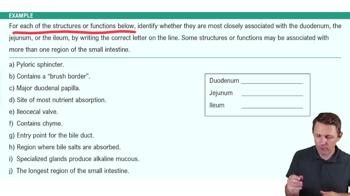
Duodenum

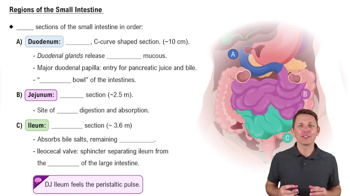
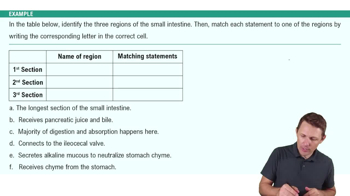
The duodenum is the first section of the small intestine, measuring about 25-30 centimeters long. It plays a crucial role in digestion by receiving chyme from the stomach and mixing it with bile from the liver and pancreatic juices. This combination helps to neutralize stomach acid and further break down food, allowing for nutrient absorption.
Video consigliato:
3:38
Small Intestine Example 4

Jejunum

The jejunum is the middle section of the small intestine, approximately 2.5 meters long. Its primary function is the absorption of nutrients, including carbohydrates, proteins, and fats. The jejunum has a highly folded inner surface, which increases the surface area for absorption, making it highly efficient in nutrient uptake.
Video consigliato:
4:25
Regions of the Small Intestine

Ileum

The ileum is the final section of the small intestine, about 3-4 meters long. It is primarily responsible for the absorption of vitamin B12 and bile salts, as well as any remaining nutrients not absorbed by the jejunum. The ileum connects to the large intestine at the ileocecal valve, regulating the flow of material into the colon.
Video consigliato:
2:25
Small Intestine Example 1
Pratica correlata
Domanda del libro di testo

How does absorption of lipids differ from absorption of carbohydrates and proteins in the small intestine?

a. Lipids are absorbed into a capillary; carbohydrates and proteins are absorbed into a lacteal.

b. Lipids are not absorbed in the small intestine.

c. Lipids are absorbed into a lacteal; carbohydrates and proteins are absorbed into a capillary.

d. They are all absorbed into the same structure.

1250
views
Domanda del libro di testo

Mark the following statements as true or false. If a statement is false, correct it to make a true statement.

b. The esophageal and pharyngeal phases of swallowing are mediated by the swallowing reflex of the brainstem and the enteric nervous system.

782
views
Domanda del libro di testo

Match the following terms with the correct definition. 

__Chief cells          

__Parietal cells           

__Gastrin           

__Pyloric sphincter         

__Diffuse neuroendocrine (DNES) cells         

__Gastroesophageal sphincter         

__Pepsin         

__Chyme

a. Hormone that stimulates multiple digestive processes

b. Enzyme that begins protein digestion

c. Produce acid and intrinsic factor

d. Liquid produced as a result of stomach churning

e. Produce pepsinogen

f. Cells in gastric glands that produce hormones

g. Controls passage of bolus from esophagus to stomach

h. Controls passage of stomach contents to duodenum

618
views
Domanda del libro di testo

Which of the following best describes the microscopic structure of the liver?

a. Hexagonal plates of hepatocytes surrounding a central vein with portal triads at each corner

b. Octagonal plates of hepatocytes surrounding a central artery with portal triads at each corner

c. Irregular groups of hepatocytes surrounding a central vein with bile ducts at each corner

d. Hexagonal plates of hepatocytes surrounding a portal vein with bile ducts at each corner

784
views
Domanda del libro di testo

Which of the following statements about accessory organ secretions is not true?

a. Hepatocytes produce bile, which drains out of the liver via the common hepatic ducts.

b. Saliva contains secretory IgA and lysozyme, which play an important role in preventing the growth of pathogenic bacteria in the oral cavity.

c. Pancreatic juice contains digestive enzymes and bicarbonate ions to neutralize the acidic chyme.

d. The gallbladder produces bile, which drains out of the gallbladder via the cystic duct.

761
views
Domanda del libro di testo

The primary hormone that triggers the secretion of pancreatic juice and bile is:

a. Gastric inhibitory peptide

b. Cholecystokinin

c. Motilin

d. Somatostatin

980
views