
A patient is admitted to the hospital and given intravenous (IV) fluids. Four hours later, the patient complains that his mouth and eyes feel dry. You notice that he displays signs of dehydration, and when you check his IV, you see that he was given the wrong kind of fluids. Were these fluids likely hypotonic, isotonic, or hypertonic? Explain.
Ch. 3 The Cell
Amerman3rd EditionHuman Anatomy & PhysiologyISBN: 9780138247201, 9780138247928, 9780138201814Non è quello che usi tu?Cambia libro di testo
Capitolo 3, Problema L3.B5b
Epithelial cells of the kidneys have pumps that drive the transcellular transport of sodium ions.
The movement of sodium ions drives the transcellular transport of water. Explain why water follows sodium. (Connects to Chapter 3)
Guida verificata passo dopo passo1
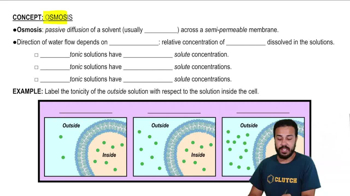
Understand the concept of osmosis: Osmosis is the movement of water across a semipermeable membrane from an area of lower solute concentration to an area of higher solute concentration. This principle is key to understanding why water follows sodium ions.
Recognize the role of sodium ions in creating a concentration gradient: Sodium ions are actively transported out of the epithelial cells of the kidneys into the interstitial fluid using sodium-potassium pumps. This creates a higher concentration of sodium ions in the interstitial fluid compared to the inside of the cells.
Explain how the concentration gradient affects water movement: The higher concentration of sodium ions in the interstitial fluid creates a hypertonic environment. Water moves from areas of lower solute concentration (inside the cells) to areas of higher solute concentration (interstitial fluid) to balance the osmotic pressure.
Connect the process to transcellular transport: The movement of sodium ions out of the epithelial cells drives the transcellular transport of water because water follows the osmotic gradient created by the sodium ion pumps.
Relate this mechanism to kidney function: This process is essential for the kidneys to regulate water and electrolyte balance in the body, ensuring proper hydration and maintaining homeostasis.

Risposta video verificata per un problema simile:
Questa soluzione video è stata consigliata dai nostri tutor come utile per risolvere questo problema.
Concetti chiave
Ecco i concetti essenziali che devi comprendere per rispondere correttamente alla domanda.
Osmosis
Osmosis is the passive movement of water across a semipermeable membrane from an area of lower solute concentration to an area of higher solute concentration. In the context of kidney epithelial cells, when sodium ions are actively transported out of the cells, it creates a higher concentration of solutes outside the cell, prompting water to follow sodium to balance the solute concentrations.
Video consigliato:
Percorso guidato
Osmosis
Active Transport
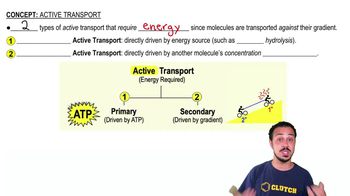
Active transport is the process by which cells move ions or molecules against their concentration gradient, requiring energy, typically in the form of ATP. In the kidneys, sodium ions are actively pumped out of epithelial cells, which is crucial for maintaining electrolyte balance and facilitating the subsequent movement of water.
Video consigliato:
Percorso guidato
Active Transport
Transcellular Transport
Transcellular transport refers to the movement of substances across the epithelial cells, involving both passive and active mechanisms. In the kidneys, sodium ions are transported transcellularly, and this movement is essential for driving water reabsorption, as water follows sodium through osmosis, thereby influencing fluid balance in the body.
Video consigliato:
Percorso guidato
Active Transport
Pratica correlata
Domanda del libro di testo
786
views
Domanda del libro di testo
A hypothetical poison prevents transcription factors from binding to the gene for tubulin proteins. What impact would this have on mitosis, and why?
783
views
Domanda del libro di testo
A popular science fiction program once had an episode that featured an 'intron virus' that 'turned on' the introns in the genes, causing the synthesis of abnormal proteins. The episode may have been entertaining, but its premise had a large flaw about the nature of introns. What was the flaw?
953
views
Domanda del libro di testo
What effect would the hypothetical poison of question 3 have on other functions of the cell? Explain.
512
views
Domanda del libro di testo
What are the two fluid compartments in the body, and how are they kept separate?
1049
views
Domanda del libro di testo
Write a single sentence, using no more than 25 words, to summarize each of the following cellular processes:
Mitosis
743
views
