Ch. 5 The Integumentary System
Amerman- Human Anatomy & Physiology 3e
Amerman3rd EditionHuman Anatomy & PhysiologyISBN: 9780138247201, 9780138247928, 9780138201814Non è quello che usi tu?Cambia libro di testo
Capitolo 5, Problema 4

Explain what happens to dermal blood vessels when heat needs to be conserved (i.e., due to a cold environment).

Guida verificata passo dopo passo
1
Understand the role of dermal blood vessels in thermoregulation: Dermal blood vessels are part of the body's mechanism to regulate temperature. They can constrict or dilate to either conserve or release heat.
Identify the physiological response to cold environments: When the body is exposed to cold, it needs to conserve heat to maintain core temperature. This triggers a process called vasoconstriction.
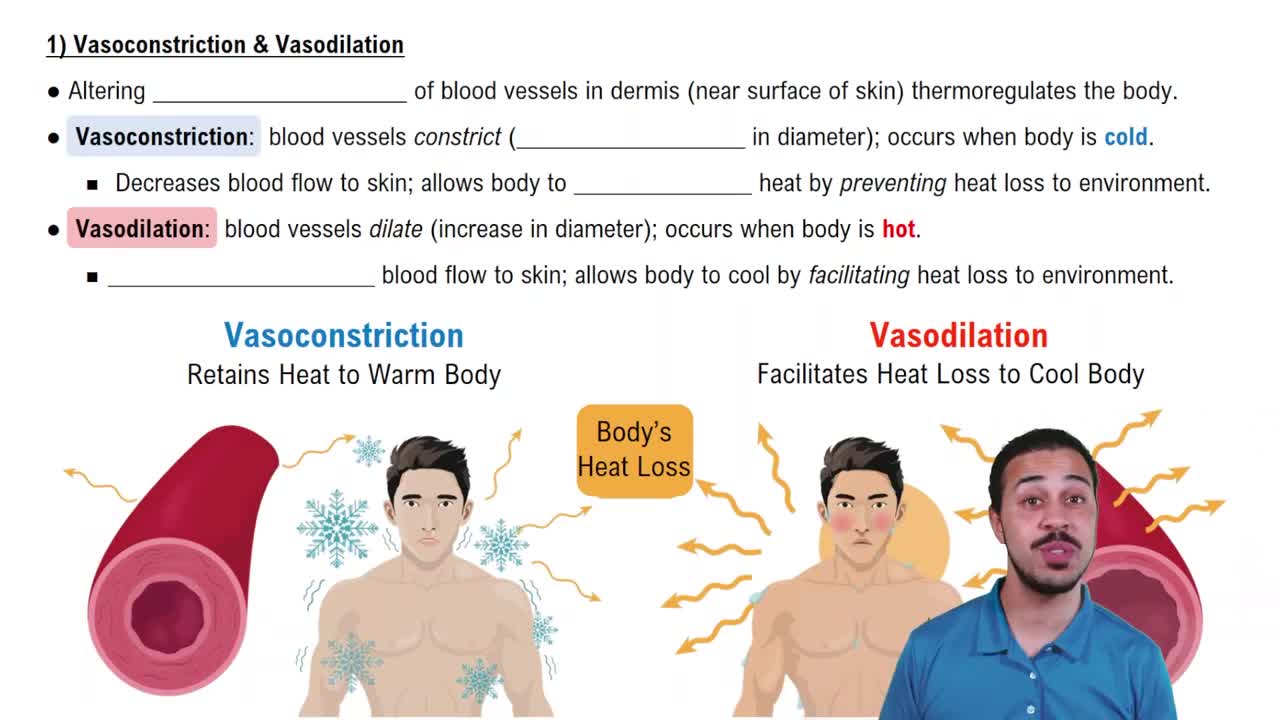
Explain vasoconstriction: Vasoconstriction is the narrowing of blood vessels, particularly in the dermis. This reduces blood flow to the skin, minimizing heat loss to the external environment.
Describe the role of the sympathetic nervous system: The sympathetic nervous system activates vasoconstriction by releasing neurotransmitters like norepinephrine, which bind to receptors on the smooth muscle of blood vessels, causing them to contract.
Discuss the overall effect: By reducing blood flow to the skin, the body conserves heat and prioritizes maintaining warmth in vital organs, ensuring survival in cold conditions.

Risposta video verificata per un problema simile:

Questa soluzione video è stata consigliata dai nostri tutor come utile per risolvere questo problema.

Concetti chiave

Ecco i concetti essenziali che devi comprendere per rispondere correttamente alla domanda.

Vasoconstriction

Vasoconstriction is the process by which blood vessels narrow, reducing blood flow to the skin's surface. This physiological response occurs when the body needs to conserve heat, especially in cold environments. By limiting blood flow to the dermal blood vessels, the body minimizes heat loss, helping to maintain core temperature.
Video consigliato:
Percorso guidato
05:07
Vasoconstriction & Vasodilation

Thermoregulation

Thermoregulation is the body's ability to maintain its internal temperature within a narrow range, despite external temperature fluctuations. It involves various mechanisms, including vasoconstriction and vasodilation, to either conserve or dissipate heat. This process is crucial for ensuring that enzymatic and metabolic functions operate optimally.
Video consigliato:
Percorso guidato
01:07
Introduction to Thermoregulation

Hypothalamus

The hypothalamus is a small region of the brain that plays a key role in regulating body temperature. It acts as the body's thermostat, detecting changes in temperature and initiating appropriate responses, such as vasoconstriction when the environment is cold. This ensures that the body can adapt to varying external conditions to maintain homeostasis.
Video consigliato:
6:11
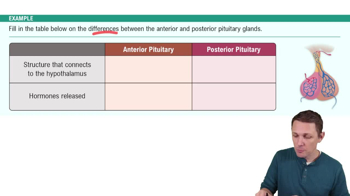
The Hypothalamus and Pituitary Gland Example 3
Pratica correlata
Domanda del libro di testo

Would a mild second-degree burn be likely to heal by regeneration or fibrosis? Would the same type of healing take place in a third-degree burn that involved muscle tissue? Why or why not?

960
views

Domanda del libro di testo

The disease pemphigus vulgaris involves a patient's own immune system attacking the desmosomes between the epithelial cells of the skin. What changes would you expect to see with this disease?

989
views
Domanda del libro di testo

Number the strata of thick skin epidermis from deepest (1) to most superficial (5). 

____Stratum spinosum     

____Stratum corneum     

____Stratum basale     

____Stratum lucidum     

____Stratum granulosum

958
views
Domanda del libro di testo

Mark the following statements as true or false. If a statement is false, correct it to make a true statement.

Melanocytes account for the bulk of the epidermis.

958
views
Domanda del libro di testo

Keratinocytes in the superficial strata of the epidermis die because:

a. They are too far away from the blood supply in the dermis.

b. They are surrounded by a lipid-based substance that makes them more permeable to water.

c. They do not die.

d. No keratinocytes in the epidermis are alive.

983
views
Domanda del libro di testo

Nguyen comes to your clinic with a mole that has recently changed in appearance. You examine the mole and note that its borders are irregular, it has a deep blue-black color, and the color is unevenly distributed throughout the mole.

What is your immediate concern? Why?

43
views