Ch. 13 The Respiratory System
Marieb - Essentials of Human Anatomy & Physiology 13th Edition
Marieb13th EditionEssentials of Human Anatomy & PhysiologyISBN: 9780135624340Non è quello che usi tu?Cambia libro di testo
Capitolo 13, Problema 13

The contraction of the diaphragm and the external intercostal muscles begins inspiration. What happens, in terms of volume and pressure changes in the lungs, when these muscles contract?

Guida verificata passo dopo passo
1
When the diaphragm contracts, it moves downward, and the external intercostal muscles contract to lift the rib cage upward and outward. This increases the volume of the thoracic cavity.
As the thoracic cavity volume increases, the lungs expand due to the pleural membranes adhering to the thoracic wall. This expansion increases the volume of the lungs.
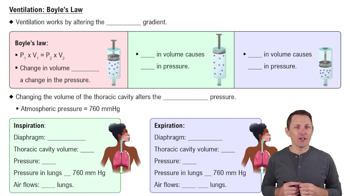
According to Boyle's Law, which states that pressure and volume are inversely related (P ∝ 1/V), the increase in lung volume leads to a decrease in intrapulmonary pressure (pressure inside the lungs).
The intrapulmonary pressure becomes lower than the atmospheric pressure, creating a pressure gradient that allows air to flow into the lungs (inhalation).
This process continues until the intrapulmonary pressure equals the atmospheric pressure, at which point air flow into the lungs stops, completing the inspiration phase.

Risposta video verificata per un problema simile:

Questa soluzione video è stata consigliata dai nostri tutor come utile per risolvere questo problema.
Durata del video:
2m

Concetti chiave

Ecco i concetti essenziali che devi comprendere per rispondere correttamente alla domanda.

Diaphragm and Intercostal Muscles

The diaphragm is a dome-shaped muscle that separates the thoracic cavity from the abdominal cavity, while the external intercostal muscles are located between the ribs. During inspiration, the contraction of these muscles increases the volume of the thoracic cavity, allowing the lungs to expand. This expansion is crucial for drawing air into the lungs.

Boyle's Law

Boyle's Law states that the pressure of a gas is inversely proportional to its volume when temperature is held constant. As the diaphragm and intercostal muscles contract, the volume of the thoracic cavity increases, leading to a decrease in pressure within the lungs. This pressure drop allows air to flow into the lungs from the higher-pressure atmosphere.
Video consigliato:
4:23
Ventilation: Boyle’s Law

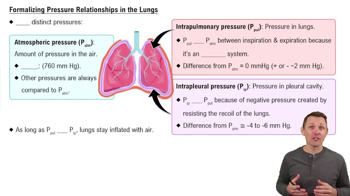
Intrapulmonary Pressure

Intrapulmonary pressure refers to the pressure within the alveoli of the lungs. During inspiration, as the volume of the thoracic cavity increases due to muscle contraction, the intrapulmonary pressure falls below atmospheric pressure. This pressure gradient is what drives air into the lungs, facilitating the process of breathing.
Video consigliato:
5:46
Formalizing Pressure Relationships in the Lungs