Ch. 12 Nervous Tissue
Martini - Fundamentals of Anatomy & Physiology 11th Edition
Martini, Nath, Bartholomew11th EditionFundamentals of Anatomy & PhysiologyISBN: 9780136874089Non è quello che usi tu?Cambia libro di testo
Capitolo 12, Problema 9b

What are the major components of the peripheral nervous system?

Guida verificata passo dopo passo
1
Understand that the peripheral nervous system (PNS) consists of all the nerves and ganglia outside the brain and spinal cord, connecting the central nervous system (CNS) to the rest of the body.
Identify the two main divisions of the PNS: the sensory (afferent) division and the motor (efferent) division.
Recognize that the sensory division carries information from sensory receptors to the CNS, while the motor division transmits commands from the CNS to muscles and glands.
Further divide the motor division into the somatic nervous system, which controls voluntary movements of skeletal muscles, and the autonomic nervous system, which regulates involuntary functions like heart rate and digestion.
Note that the autonomic nervous system itself has two subdivisions: the sympathetic division (responsible for 'fight or flight' responses) and the parasympathetic division (responsible for 'rest and digest' activities).

Risposta video verificata per un problema simile:

Questa soluzione video è stata consigliata dai nostri tutor come utile per risolvere questo problema.

Concetti chiave

Ecco i concetti essenziali che devi comprendere per rispondere correttamente alla domanda.

Peripheral Nervous System (PNS)

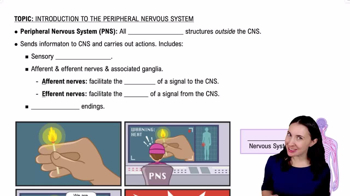
The peripheral nervous system consists of all the nerves and ganglia outside the brain and spinal cord. It connects the central nervous system to limbs and organs, facilitating communication between the body and brain.
Video consigliato:
3:33
Peripheral Nervous System

Somatic Nervous System

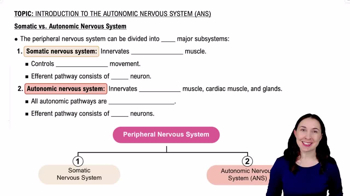
The somatic nervous system is a part of the PNS responsible for voluntary control of skeletal muscles. It transmits sensory information to the CNS and carries motor commands to muscles, enabling conscious movement.
Video consigliato:
1:50
Somatic vs. Autonomic Nervous System

Autonomic Nervous System

The autonomic nervous system controls involuntary bodily functions like heart rate, digestion, and respiration. It is divided into sympathetic and parasympathetic divisions, which have opposing effects to maintain homeostasis.
Video consigliato:
1:50
Somatic vs. Autonomic Nervous System