Domanda del libro di testo
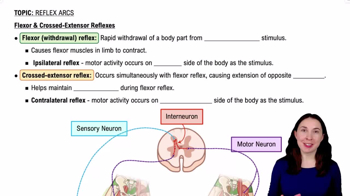
The reflexes that control the most rapid, stereotyped motor responses to stimuli are
(a) Monosynaptic reflexes
(b) Polysynaptic reflexes
(c) Tendon reflexes
(d) Extensor reflexes
877
views

 Martini, Nath, Bartholomew 11th EditionCh. 13 The Spinal Cord, Spinal Nerves, and Spinal ReflexesProblema 13
 Guida verificata passo dopo passo
 05:03
05:03
 2:42
2:42 3:33
3:33The reflexes that control the most rapid, stereotyped motor responses to stimuli are
(a) Monosynaptic reflexes
(b) Polysynaptic reflexes
(c) Tendon reflexes
(d) Extensor reflexes
The synapsing of several neurons on the same postsynaptic neuron is called
(a) Serial processing
(b) Reverberation
(c) Divergence
(d) Convergence
Proceeding deep from the most superficial structure, number the following in the correct sequence:
(a) _____ walls of vertebral canal
(b) _____ dura mater
(c) _____ subdural space
(d) _____ epidural space
(e) _____ pia mater
(f) _____ arachnoid membrane
(g) _____ subarachnoid space
(h) _____ spinal cord
List, in sequence, the five steps involved in a neural reflex.
Reflex arcs in which the sensory stimulus and the motor response occur on the same side of the body are:
(a) Contralateral
(b) Paraesthetic
c) Ipsilateral
(d) Monosynaptic.
The genitofemoral, femoral, and lateral femoral cutaneous nerves are major nerves of the
(a) Lumbar plexus
(b) Sacral plexus
(c) Brachial plexus
(d) Cervical plexus