Ch. 15 Sensory Pathways and the Somatic Nervous System
Martini - Fundamentals of Anatomy & Physiology 11th Edition
Martini, Nath, Bartholomew11th EditionFundamentals of Anatomy & PhysiologyISBN: 9780136874089Non è quello che usi tu?Cambia libro di testo
Capitolo 15, Problema 2

_______ receptors are normally inactive, but become active for a short time whenever there is a change in the modality that they monitor.

Guida verificata passo dopo passo
1
Understand the question is asking about a type of receptor that is usually inactive but activates briefly when there is a change in the stimulus it monitors.
Recall that sensory receptors can be classified based on how they respond to stimuli: some respond continuously, while others respond only to changes.
Identify that receptors which respond only to changes in stimulus intensity or modality are called 'phasic receptors' or 'adaptation receptors'.
Phasic receptors quickly adapt to a constant stimulus and become inactive, but they fire impulses when the stimulus changes, signaling new information.
Therefore, the answer involves recognizing that these receptors are called 'phasic receptors' because they are normally inactive but activate briefly upon changes in the monitored modality.

Risposta video verificata per un problema simile:

Questa soluzione video è stata consigliata dai nostri tutor come utile per risolvere questo problema.

Concetti chiave

Ecco i concetti essenziali che devi comprendere per rispondere correttamente alla domanda.

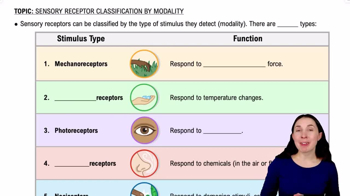
Receptor Modality

Receptor modality refers to the specific type of stimulus a sensory receptor is sensitive to, such as light, sound, or pressure. Each receptor is specialized to detect changes in its particular modality, enabling the nervous system to interpret different environmental signals accurately.
Video consigliato:
2:11
Sensory Receptor Classification by Modality

Phasic Receptors

Phasic receptors are sensory receptors that remain inactive when a stimulus is constant but become active briefly when there is a change in the stimulus. They are important for detecting changes or new events in the environment, such as the onset or removal of a stimulus.
Video consigliato:
1:17
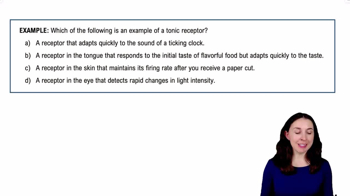
Adaptation of Sensory Receptors Example 1

Sensory Adaptation

Sensory adaptation is the process by which sensory receptors reduce their response to a constant stimulus over time. This allows the nervous system to focus on new or changing stimuli, preventing overload from unchanging background information.
Video consigliato:
1:17
Adaptation of Sensory Receptors Example 1