What three types of mechanoreceptors respond to stretching, compression, twisting, or other distortions of their plasma membrane?
Ch. 15 Sensory Pathways and the Somatic Nervous System
Martini, Nath, Bartholomew11th EditionFundamentals of Anatomy & PhysiologyISBN: 9780136874089Non è quello che usi tu?Cambia libro di testo
Tutti i libri di testo
Martini, Nath, Bartholomew 11th Edition
Ch. 15 Sensory Pathways and the Somatic Nervous System
Problema 3
Martini, Nath, Bartholomew 11th Edition
Ch. 15 Sensory Pathways and the Somatic Nervous System
Problema 3Capitolo 15, Problema 3
The CNS interprets information entirely on the basis of the
(a) Number of action potentials that it receives
(b) Kind of action potentials that it receives
(c) Line over which sensory information arrives
(d) Intensity of the sensory stimulus
(e) Number of sensory receptors that are stimulated
Guida verificata passo dopo passo1
Understand that the Central Nervous System (CNS) interprets sensory information based on how the information is transmitted rather than the strength or number of signals alone.
Recall the concept of the 'labeled line' principle, which states that the CNS identifies the type of stimulus based on the specific pathway or nerve fiber (line) that carries the sensory information.
Recognize that the CNS does not distinguish stimuli by the kind of action potentials themselves, since all action potentials are essentially the same in form and strength.
Note that the intensity of a stimulus is encoded by the frequency of action potentials, but the CNS primarily uses the pathway to determine the nature of the stimulus.
Conclude that the CNS interprets information mainly based on the specific line over which sensory information arrives, making option (c) the key concept.

Risposta video verificata per un problema simile:
Questa soluzione video è stata consigliata dai nostri tutor come utile per risolvere questo problema.
Concetti chiave
Ecco i concetti essenziali che devi comprendere per rispondere correttamente alla domanda.
Labeled Line Principle
The CNS interprets sensory information based on the specific neural pathway or 'line' over which the signals arrive. Each sensory modality has dedicated pathways, so the brain identifies the type of stimulus by the origin of the incoming action potentials, regardless of their number or intensity.
Video consigliato:
Percorso guidato
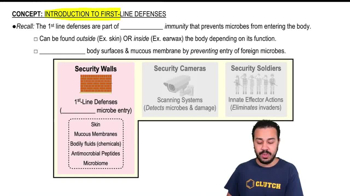
First-Line Defenses
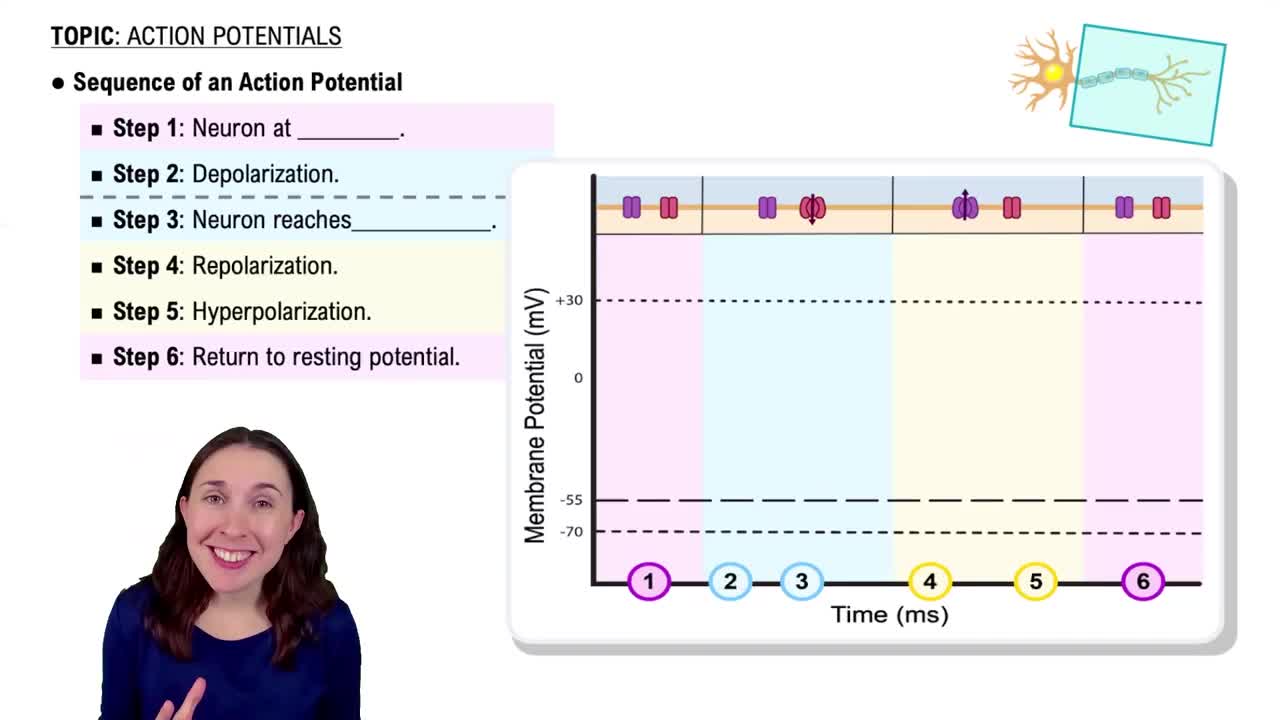
Action Potentials and Neural Coding
Action potentials are uniform electrical signals; their frequency and pattern encode stimulus intensity and duration, but the CNS does not distinguish 'kinds' of action potentials. Instead, it relies on where the signals come from to interpret sensory information.
Video consigliato:
Action Potential
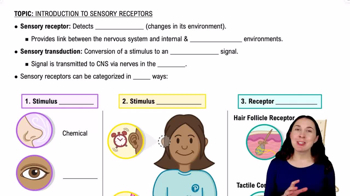
Sensory Receptor Specificity
Different sensory receptors respond to specific types of stimuli and send signals through dedicated pathways. The number of receptors activated can influence stimulus perception, but the CNS primarily uses the pathway identity to determine the nature of the stimulus.
Video consigliato:
Sensory Receptors
Pratica correlata
Domanda del libro di testo
821
views
Domanda del libro di testo
Identify and shade in the locations of all the ascending sensory tracts in the following diagram of the spinal cord.
724
views
Domanda del libro di testo
_______ receptors are normally inactive, but become active for a short time whenever there is a change in the modality that they monitor.
767
views
Domanda del libro di testo
The larger the receptive field, the
(a) Larger the stimulus needed to stimulate a sensory receptor
(b) Fewer sensory receptors there are
(c) Harder it is to locate the exact point of stimulation
(d) Larger the area of the somatosensory cortex in the brain that deals with the area
(e) Closer together the receptor cells
1075
views
Domanda del libro di testo
Identify six types of tactile receptors located in the skin, and describe their sensitivities.
1064
views