Ch. 16 The Autonomic Nervous System and Higher-Order Functions
Martini - Fundamentals of Anatomy & Physiology 11th Edition
Martini, Nath, Bartholomew11th EditionFundamentals of Anatomy & PhysiologyISBN: 9780136874089Non è quello che usi tu?Cambia libro di testo
Capitolo 16, Problema 6

Starting in the spinal cord, trace an action potential through the sympathetic division of the ANS until it reaches a target organ in the abdominopelvic region.

Guida verificata passo dopo passo
1
Begin by identifying the origin of the sympathetic preganglionic neuron in the spinal cord, specifically in the lateral horn of the thoracolumbar region (T1 to L2).
Trace the preganglionic axon as it exits the spinal cord through the ventral root and enters the spinal nerve, then passes into the white ramus communicans to reach the sympathetic trunk (chain) ganglion.
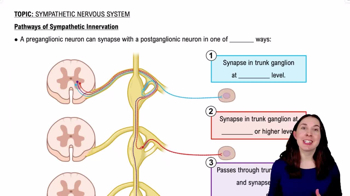
Determine whether the preganglionic neuron synapses in the sympathetic trunk ganglion at the same level, ascends or descends to another ganglion, or passes through without synapsing to reach a prevertebral (collateral) ganglion closer to the target organ in the abdominopelvic region.
If the preganglionic fiber passes through the sympathetic trunk without synapsing, follow it as a splanchnic nerve to a prevertebral ganglion (such as the celiac, superior mesenteric, or inferior mesenteric ganglion), where it synapses with a postganglionic neuron.
Finally, trace the postganglionic neuron from the prevertebral ganglion to the target organ in the abdominopelvic region, where it releases neurotransmitters to elicit the sympathetic response.

Risposta video verificata per un problema simile:

Questa soluzione video è stata consigliata dai nostri tutor come utile per risolvere questo problema.

Concetti chiave

Ecco i concetti essenziali che devi comprendere per rispondere correttamente alla domanda.

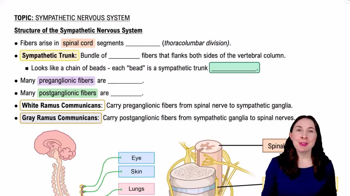
Sympathetic Division of the Autonomic Nervous System

The sympathetic division is part of the autonomic nervous system responsible for the 'fight or flight' response. It originates in the thoracolumbar region of the spinal cord and prepares the body for stressful situations by increasing heart rate, dilating airways, and redirecting blood flow to muscles.
Video consigliato:
7:55
Structure of the Sympathetic Nervous System

Pathway of Sympathetic Preganglionic and Postganglionic Neurons

An action potential starts in the spinal cord's lateral horn, where preganglionic neurons exit via the ventral root and enter the sympathetic chain ganglia. From there, the signal may synapse in the chain or pass through to collateral ganglia before postganglionic neurons carry the impulse to target organs.
Video consigliato:
3:09
Pathways of Sympathetic Innervation

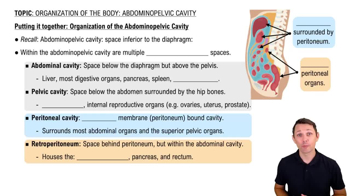
Innervation of Abdominopelvic Target Organs

Sympathetic fibers reach abdominopelvic organs through splanchnic nerves that synapse in collateral ganglia like the celiac or inferior mesenteric ganglia. Postganglionic fibers then innervate organs such as the stomach, intestines, kidneys, and bladder, modulating functions like digestion and blood flow.
Video consigliato:
5:46
Organization of the Abdominopelvic Cavity