
Ch. 17 The Special Senses
Martini - Fundamentals of Anatomy & Physiology 11th Edition
Martini, Nath, Bartholomew11th EditionFundamentals of Anatomy & PhysiologyISBN: 9780136874089Non è quello che usi tu?Cambia libro di testo
Capitolo 17, Problema 25

Your friend Shelly suffers from myopia (nearsightedness). You remember from your physics class that concave lenses cause light waves to spread or diverge and that convex lenses cause light waves to converge. What type of corrective lenses would you suggest to your friend?
(a) Concave lenses
(b) Convex lenses

Guida verificata passo dopo passo
1
Understand the condition: Myopia, or nearsightedness, means that distant objects appear blurry because the eye focuses images in front of the retina instead of directly on it.
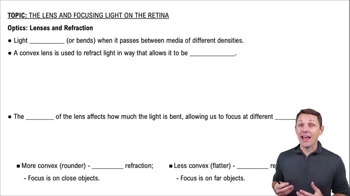
Recall lens behavior: Concave lenses cause light rays to diverge (spread out), while convex lenses cause light rays to converge (come together).
Analyze the problem: Since myopia causes light to focus too early (in front of the retina), the corrective lens needs to spread the light rays out slightly so they focus further back, directly on the retina.
Match the lens type: Because concave lenses cause light to diverge, they are used to correct myopia by moving the focal point back onto the retina.
Conclude the recommendation: Therefore, the appropriate corrective lenses for myopia are concave lenses.

Risposta video verificata per un problema simile:

Questa soluzione video è stata consigliata dai nostri tutor come utile per risolvere questo problema.

Concetti chiave

Ecco i concetti essenziali che devi comprendere per rispondere correttamente alla domanda.

Myopia (Nearsightedness)

Myopia is a common vision condition where distant objects appear blurry because the eye focuses images in front of the retina instead of directly on it. This occurs when the eyeball is too long or the cornea is too curved, causing light rays to converge prematurely.

Concave Lenses and Light Divergence

Concave lenses are thinner at the center and thicker at the edges, causing incoming light rays to spread out or diverge. This divergence helps move the focal point backward, which is useful for correcting myopia by adjusting where light focuses on the retina.
Video consigliato:
6:29
Optics: Lenses and Refraction

Convex Lenses and Light Convergence

Convex lenses are thicker at the center and thinner at the edges, causing light rays to converge or come together. They are typically used to correct hyperopia (farsightedness) by moving the focal point forward onto the retina, which is the opposite of what is needed for myopia.
Video consigliato:
6:29
Optics: Lenses and Refraction