
Ch. 18 The Endocrine System
Martini - Fundamentals of Anatomy & Physiology 11th Edition
Martini, Nath, Bartholomew11th EditionFundamentals of Anatomy & PhysiologyISBN: 9780136874089Non è quello che usi tu?Cambia libro di testo
Capitolo 18, Problema 2

Cyclic AMP functions as a second messenger to:
(a) Build proteins and catalyze specific reactions
(b) Activate adenylate cyclase
(c) Open ion channels and activate key enzymes in the cytoplasm
(d) Bind the hormone–receptor complex to DNA segments

Guida verificata passo dopo passo
1
Step 1: Understand the role of cyclic AMP (cAMP) as a second messenger in cellular signaling pathways. It is produced inside the cell in response to the binding of a hormone or ligand to a receptor on the cell surface.
Step 2: Recall that cAMP does not directly build proteins or catalyze reactions; instead, it transmits the signal from the receptor to intracellular targets.
Step 3: Recognize that cAMP is synthesized by the enzyme adenylate cyclase, so it does not activate adenylate cyclase itself; rather, adenylate cyclase produces cAMP.
Step 4: Know that cAMP primarily functions by activating protein kinase A (PKA), which then phosphorylates specific enzymes and proteins, leading to changes such as opening ion channels and activating key enzymes in the cytoplasm.
Step 5: Understand that cAMP does not bind directly to DNA or the hormone–receptor complex; instead, it acts within the cytoplasm to propagate the signal.

Risposta video verificata per un problema simile:

Questa soluzione video è stata consigliata dai nostri tutor come utile per risolvere questo problema.

Concetti chiave

Ecco i concetti essenziali che devi comprendere per rispondere correttamente alla domanda.

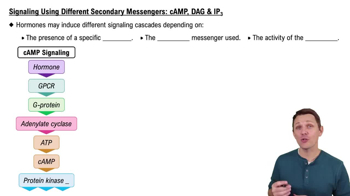
Second Messenger Systems

Second messengers are molecules that relay signals from receptors on the cell surface to target molecules inside the cell, amplifying the signal. Cyclic AMP (cAMP) is a common second messenger that transmits hormonal signals to activate intracellular processes without entering the nucleus.
Video consigliato:
10:41
Secondary Messengers

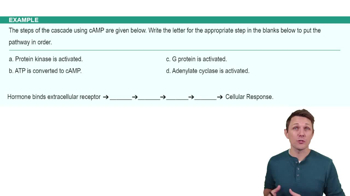
Role of Cyclic AMP (cAMP)

cAMP is synthesized from ATP by adenylate cyclase and functions primarily to activate protein kinase A (PKA). This activation leads to phosphorylation of specific enzymes and proteins, regulating various cellular activities such as metabolism and gene expression indirectly.
Video consigliato:
2:43
Membrane Bound Receptors and Secondary Messengers Example 1

Signal Transduction and Enzyme Activation

Signal transduction involves converting an extracellular signal into a cellular response. cAMP activates key enzymes and can modulate ion channels in the cytoplasm, enabling rapid cellular responses to hormones without directly interacting with DNA.
Video consigliato:
Percorso guidato
04:18
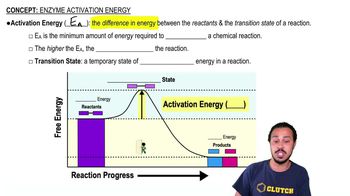
Enzyme Activation Energy