Ch. 19 Blood
Martini - Fundamentals of Anatomy & Physiology 11th Edition
Martini, Nath, Bartholomew11th EditionFundamentals of Anatomy & PhysiologyISBN: 9780136874089Non è quello che usi tu?Cambia libro di testo
Capitolo 19, Problema 5

Serum is:
(a) The same as blood plasma
(b) Plasma minus the formed elements
(c) Plasma minus the proteins
(d) Plasma minus fibrinogen
(e) Plasma minus the electrolytes

Guida verificata passo dopo passo
1
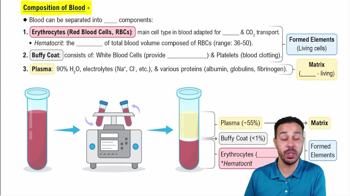
Step 1: Understand the components of blood. Blood consists of formed elements (cells like red blood cells, white blood cells, and platelets) suspended in plasma, which is the liquid portion containing water, electrolytes, proteins, and other substances.
Step 2: Define plasma. Plasma is the fluid part of blood that includes water, electrolytes, proteins (such as albumin, globulins, and fibrinogen), nutrients, hormones, and waste products, but it still contains clotting factors like fibrinogen.
Step 3: Define serum. Serum is the fluid that remains after blood has clotted and the clot has been removed. This means serum is plasma without the clotting proteins, primarily fibrinogen.
Step 4: Compare the options given. Since serum is plasma minus the clotting proteins, especially fibrinogen, the correct description is 'plasma minus fibrinogen'.
Step 5: Conclude that the correct answer corresponds to the option describing serum as plasma without fibrinogen, which is option (d).

Risposta video verificata per un problema simile:

Questa soluzione video è stata consigliata dai nostri tutor come utile per risolvere questo problema.

Concetti chiave

Ecco i concetti essenziali che devi comprendere per rispondere correttamente alla domanda.

Blood Plasma

Blood plasma is the liquid component of blood that contains water, electrolytes, proteins, nutrients, hormones, and waste products. It serves as a transport medium for cells and various substances throughout the body. Plasma includes clotting factors such as fibrinogen.
Video consigliato:
Percorso guidato
7:49
Composition of Blood

Serum

Serum is the fluid portion of blood obtained after clotting has occurred, meaning it is plasma without the clotting proteins like fibrinogen. It contains electrolytes, antibodies, antigens, hormones, and other proteins but lacks fibrinogen and other clotting factors.
Video consigliato:
Percorso guidato
9:16
Outcomes of Antibody Binding to Antigen

Difference Between Plasma and Serum

The key difference is that plasma contains fibrinogen and other clotting factors, while serum does not because these are consumed during clot formation. Understanding this distinction helps in interpreting blood tests and clinical diagnostics.
Video consigliato:
03:04
The Difference Between Anatomy and Physiology