
Ch. 2 The Chemical Level of Organization
Martini - Fundamentals of Anatomy & Physiology 11th Edition
Martini, Nath, Bartholomew11th EditionFundamentals of Anatomy & PhysiologyISBN: 9780136874089Non è quello che usi tu?Cambia libro di testo
Capitolo 2, Problema 25

What is a salt? How does a salt differ from an acid or a base?

Guida verificata passo dopo passo
1
Step 1: Define what a salt is in the context of chemistry and physiology. A salt is a compound formed when an acid reacts with a base, resulting in the neutralization of their properties and the formation of ionic compounds composed of cations (positively charged ions) and anions (negatively charged ions).
Step 2: Explain the formation of salts through a neutralization reaction, which can be represented by the general equation: \(\text{Acid} + \text{Base} \rightarrow \text{Salt} + \text{Water}\). For example, \(\mathrm{HCl} + \mathrm{NaOH} \rightarrow \mathrm{NaCl} + \mathrm{H_2O}\).
Step 3: Clarify how salts differ from acids. Acids are substances that release hydrogen ions (\(\mathrm{H^+}\)) in solution, increasing the concentration of \(\mathrm{H^+}\) ions and lowering the pH below 7.
Step 4: Clarify how salts differ from bases. Bases are substances that release hydroxide ions (\(\mathrm{OH^-}\)) in solution, increasing the concentration of \(\mathrm{OH^-}\) ions and raising the pH above 7.
Step 5: Summarize that unlike acids and bases, salts typically do not release \(\mathrm{H^+}\) or \(\mathrm{OH^-}\) ions directly in solution, and their pH can vary depending on the nature of the ions they contain, often resulting in a neutral or near-neutral pH.

Risposta video verificata per un problema simile:

Questa soluzione video è stata consigliata dai nostri tutor come utile per risolvere questo problema.
Durata del video:
3m

Concetti chiave

Ecco i concetti essenziali che devi comprendere per rispondere correttamente alla domanda.

Definition of a Salt

A salt is a chemical compound formed when an acid reacts with a base, resulting in the replacement of hydrogen ions in the acid with metal or ammonium ions. Salts typically consist of positive and negative ions and are usually solid crystals that can dissolve in water.
Video consigliato:
4:37
Introduction to the Endocrine System Example 2

Characteristics of Acids

Acids are substances that release hydrogen ions (H⁺) when dissolved in water, making the solution acidic. They have a sour taste, can conduct electricity, and react with metals to produce hydrogen gas. Examples include hydrochloric acid and sulfuric acid.
Video consigliato:
00:48
5 Characteristics of Epithelia

Characteristics of Bases

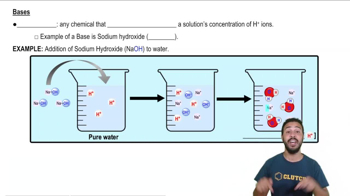
Bases are substances that release hydroxide ions (OH⁻) in aqueous solutions, making the solution basic or alkaline. They often have a bitter taste, slippery feel, and can neutralize acids. Common bases include sodium hydroxide and ammonia.
Video consigliato: