Ch. 2 The Chemical Level of Organization
Martini - Fundamentals of Anatomy & Physiology 11th Edition
Martini, Nath, Bartholomew11th EditionFundamentals of Anatomy & PhysiologyISBN: 9780136874089Non è quello che usi tu?Cambia libro di testo
Capitolo 2, Problema 23

A dehydration synthesis reaction between glycerol and a single fatty acid would yield a(n)
(a) Micelle
(b) Omega-3 fatty acid
(c) Triglyceride
(d) Monoglyceride
(e) Diglyceride

Guida verificata passo dopo passo
1
Understand the components involved: glycerol is a three-carbon molecule with three hydroxyl (-OH) groups, and a fatty acid is a long hydrocarbon chain with a carboxyl (-COOH) group.
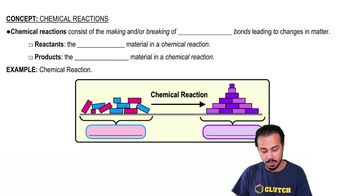
Recall that a dehydration synthesis reaction involves the removal of a water molecule (H₂O) when two molecules are joined together, typically between a hydroxyl group and a carboxyl group forming an ester bond.
Since glycerol has three hydroxyl groups, it can form up to three ester bonds with fatty acids. When only one fatty acid is attached to glycerol via one ester bond, the product is called a monoglyceride.
Review the definitions of the answer choices: a triglyceride has three fatty acids attached, a diglyceride has two, and a monoglyceride has one fatty acid attached to glycerol.
Conclude that the dehydration synthesis between glycerol and a single fatty acid yields a monoglyceride.

Risposta video verificata per un problema simile:

Questa soluzione video è stata consigliata dai nostri tutor come utile per risolvere questo problema.
Durata del video:
2m

Concetti chiave

Ecco i concetti essenziali che devi comprendere per rispondere correttamente alla domanda.

Dehydration Synthesis Reaction

Dehydration synthesis is a chemical reaction where two molecules join together by removing a water molecule. In biological systems, this process commonly links fatty acids to glycerol, forming ester bonds and creating larger molecules like lipids.
Video consigliato:
Percorso guidato
01:56
Chemical Reactions

Glycerol and Fatty Acids Structure

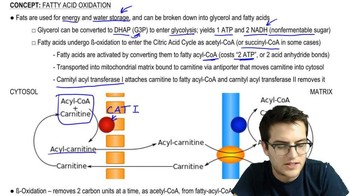
Glycerol is a three-carbon molecule with hydroxyl groups, while fatty acids are long hydrocarbon chains with a carboxyl group. When combined, fatty acids attach to glycerol’s hydroxyl groups through ester bonds, forming different types of glycerides depending on the number of fatty acids attached.
Video consigliato:
Percorso guidato
11:34
Fatty Acid Oxidation 1

Types of Glycerides

Glycerides are lipids formed by esterification of glycerol with fatty acids. A monoglyceride has one fatty acid attached, a diglyceride has two, and a triglyceride has three. The number of fatty acids determines the molecule’s structure and function in biological systems.
Video consigliato:
Percorso guidato
3:00
Types-Of-Phosphorylation-C-2-V-1