Ch. 2 The Chemical Level of Organization
Martini - Fundamentals of Anatomy & Physiology 11th Edition
Martini, Nath, Bartholomew11th EditionFundamentals of Anatomy & PhysiologyISBN: 9780136874089Non è quello che usi tu?Cambia libro di testo
Capitolo 2, Problema 21

What three components are required to create the high-energy compound ATP?

Guida verificata passo dopo passo
1
Understand that ATP (adenosine triphosphate) is a molecule that stores and transfers energy within cells, essential for many biological processes.
Identify the three main components of ATP: a nitrogenous base, a sugar molecule, and phosphate groups.
Recognize that the nitrogenous base in ATP is adenine, which is a purine base.
Know that the sugar component is ribose, a five-carbon sugar that connects adenine to the phosphate groups.
Understand that ATP contains three phosphate groups linked in a chain, and the bonds between these phosphates store high amounts of energy.

Risposta video verificata per un problema simile:

Questa soluzione video è stata consigliata dai nostri tutor come utile per risolvere questo problema.
Durata del video:
3m

Concetti chiave

Ecco i concetti essenziali che devi comprendere per rispondere correttamente alla domanda.

Adenine

Adenine is a nitrogenous base that forms part of the ATP molecule. It pairs with ribose to create adenosine, which is the core structure to which phosphate groups attach, making it essential for ATP's identity.
Video consigliato:
Percorso guidato
01:05
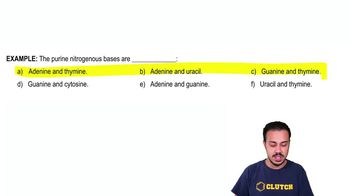
Nucleic Acids Example 2

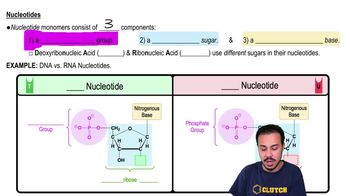
Ribose Sugar

Ribose is a five-carbon sugar that connects adenine to the phosphate groups in ATP. It acts as the backbone of the molecule, linking the nitrogenous base to the phosphate chain, enabling the formation of adenosine triphosphate.
Video consigliato:

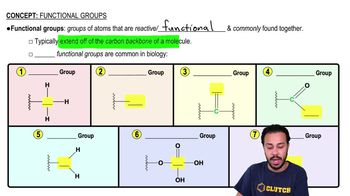
Phosphate Groups

ATP contains three phosphate groups linked by high-energy bonds. These phosphate groups store and release energy during cellular processes, making them critical for ATP's role as the cell’s primary energy carrier.
Video consigliato:
Percorso guidato
06:04
Functional Groups