Ch. 21 Blood Vessels and Circulation
Martini - Fundamentals of Anatomy & Physiology 11th Edition
Martini, Nath, Bartholomew11th EditionFundamentals of Anatomy & PhysiologyISBN: 9780136874089Non è quello che usi tu?Cambia libro di testo
Capitolo 21, Problema 19

A major difference between the arterial and venous systems is that 
(a) Arteries are usually more superficial than veins.
(b) In the limbs there is dual venous drainage.
(c) Veins are usually less branched compared to arteries.
(d) Veins exhibit a much more orderly pattern of branching in the limbs.
(e) Veins are not found in the abdominal cavity.

Guida verificata passo dopo passo
1
Understand the structure and function of arteries and veins: Arteries carry blood away from the heart and are typically thicker and more elastic to handle higher pressure. Veins return blood to the heart and have thinner walls, often containing valves to prevent backflow.
Review the anatomical arrangement of veins in the limbs: In the limbs, veins often have dual drainage systems, consisting of superficial veins (closer to the skin) and deep veins (closer to the muscles). This is a key difference compared to arteries, which do not have dual systems.
Compare the branching patterns of arteries and veins: Arteries tend to have a more orderly and predictable branching pattern, while veins are more variable and interconnected, especially in the limbs.
Clarify the presence of veins in the abdominal cavity: Veins are indeed found in the abdominal cavity, such as the inferior vena cava and portal vein, which are critical for venous return and nutrient transport.
Eliminate incorrect options based on anatomical knowledge: Use the above information to rule out options that contradict the structure, function, or anatomical arrangement of arteries and veins, focusing on the correct answer regarding dual venous drainage in the limbs.

Risposta video verificata per un problema simile:

Questa soluzione video è stata consigliata dai nostri tutor come utile per risolvere questo problema.

Concetti chiave

Ecco i concetti essenziali che devi comprendere per rispondere correttamente alla domanda.

Arterial vs. Venous Structure

The arterial system consists of blood vessels that carry oxygenated blood away from the heart, typically featuring thicker, more muscular walls to withstand higher pressure. In contrast, veins return deoxygenated blood to the heart and have thinner walls with less muscle and elasticity, allowing them to accommodate varying blood volumes.
Video consigliato:
Percorso guidato
1:42
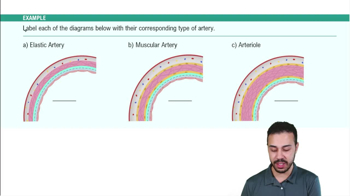
Arteries Example 1

Venous Drainage Patterns

In the limbs, veins often exhibit a dual drainage system, meaning that there are two sets of veins (superficial and deep) that work together to return blood to the heart. This dual system helps regulate blood flow and temperature, as well as providing alternative pathways in case of blockage.
Video consigliato:
Percorso guidato
4:24
Pattern Recognition Receptors

Branching Patterns of Blood Vessels

Arteries typically have a more complex and branched structure compared to veins, which tend to follow a more straightforward path. This branching is essential for distributing oxygen-rich blood efficiently throughout the body, while veins often have fewer branches, reflecting their role in collecting blood from various tissues back to the heart.
Video consigliato: