
Ch. 21 Blood Vessels and Circulation
Martini - Fundamentals of Anatomy & Physiology 11th Edition
Martini, Nath, Bartholomew11th EditionFundamentals of Anatomy & PhysiologyISBN: 9780136874089Non è quello che usi tu?Cambia libro di testo
Capitolo 21, Problema 17

What are the primary forces that cause fluid to move?
(a) Out of a capillary at its arterial end and into the interstitial fluid
(b) Into a capillary at its venous end from the interstitial fluid?

Guida verificata passo dopo passo
1
Step 1: Understand that fluid movement across capillary walls is primarily governed by two forces: hydrostatic pressure and osmotic (oncotic) pressure. Hydrostatic pressure pushes fluid out of the capillaries, while osmotic pressure pulls fluid into the capillaries.
Step 2: For part (a), at the arterial end of a capillary, the hydrostatic pressure inside the capillary is higher than the osmotic pressure, which causes fluid to move out of the capillary into the interstitial fluid. Identify this as the primary driving force for fluid filtration.
Step 3: For part (b), at the venous end of a capillary, the hydrostatic pressure decreases, and the osmotic pressure (due to plasma proteins) becomes relatively higher. This difference causes fluid to move from the interstitial fluid back into the capillary, a process called reabsorption.
Step 4: Summarize the forces for each end: (a) fluid moves out due to higher capillary hydrostatic pressure compared to osmotic pressure, and (b) fluid moves in due to higher osmotic pressure compared to hydrostatic pressure.
Step 5: Recognize that the balance between these forces is described by Starling's equation, which quantifies net fluid movement across capillaries based on hydrostatic and osmotic pressures inside and outside the capillary.

Risposta video verificata per un problema simile:

Questa soluzione video è stata consigliata dai nostri tutor come utile per risolvere questo problema.

Concetti chiave

Ecco i concetti essenziali che devi comprendere per rispondere correttamente alla domanda.

Hydrostatic Pressure

Hydrostatic pressure is the force exerted by a fluid against the walls of its container or vessel. In capillaries, it pushes fluid out of the blood vessels into the interstitial space, especially at the arterial end where this pressure is higher.
Video consigliato:
6:12
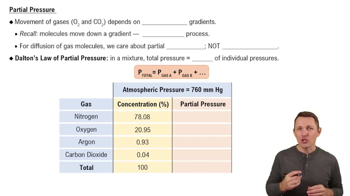
Partial Pressure

Oncotic Pressure (Colloid Osmotic Pressure)

Oncotic pressure is the osmotic pressure exerted by plasma proteins, mainly albumin, which draws water into the capillaries from the interstitial fluid. This force is stronger at the venous end of capillaries, promoting fluid reabsorption.
Video consigliato:
6:12
Partial Pressure

Starling Forces

Starling forces describe the balance between hydrostatic and oncotic pressures that regulate fluid movement across capillary membranes. The interplay of these forces determines whether fluid leaves or enters the capillaries at different points along their length.
Video consigliato:
5:45
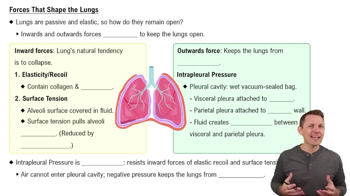
Forces That Shape the Lungs
Pratica correlata
Domanda del libro di testo

A major difference between the arterial and venous systems is that 

(a) Arteries are usually more superficial than veins.

(b) In the limbs there is dual venous drainage.

(c) Veins are usually less branched compared to arteries.

(d) Veins exhibit a much more orderly pattern of branching in the limbs.

(e) Veins are not found in the abdominal cavity.

41
views
Domanda del libro di testo

The paired arteries supplying blood to the body wall and other structures outside the abdominopelvic cavity include the:

a) Left gastric, hepatic, splenic, and phrenic arteries

(b) Adrenal, colic, lumbar, and gonadal arteries

(c) Iliac, femoral, and lumbar arteries

(d) Celiac, left gastric, and superior and inferior mesenteric arteries

988
views
Domanda del libro di testo

Which of the following conditions would have the greatest effect on peripheral resistance?

(a) Doubling the length of a vessel

(b) Doubling the diameter of a vessel

(c) Doubling the viscosity of the blood

(d) Doubling the turbulence of the blood

(e) Doubling the number of white cells in the blood

895
views
Domanda del libro di testo

The vein that drains the dural sinuses of the brain is the 

(a) Cephalic vein

(b) Great saphenous vein

(c) Internal jugular vein

(d) Superior vena cava

86
views
Domanda del libro di testo

The vein that collects most of the venous blood inferior to the diaphragm is the 

(a) Superior vena cava

(b) Great saphenous vein

(c) Inferior vena cava

(d) Azygos vein

54
views
Domanda del libro di testo

What cardiovascular changes occur at birth?

1029
views
1
rank