
Ch. 23 The Respiratory System
Martini - Fundamentals of Anatomy & Physiology 11th Edition
Martini, Nath, Bartholomew11th EditionFundamentals of Anatomy & PhysiologyISBN: 9780136874089Non è quello che usi tu?Cambia libro di testo
Capitolo 23, Problema 5

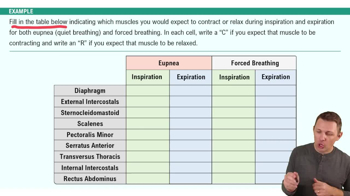
When the diaphragm and external intercostal muscles contract,
(a) Exhalation occurs.
(b) Intrapulmonary pressure increases.
(c) Intrapleural pressure decreases.
(d) The volume of the lungs decreases.
(e) The size of the thoracic cavity increases.

Guida verificata passo dopo passo
1
Step 1: Understand the role of the diaphragm and external intercostal muscles during breathing. When these muscles contract, they cause the thoracic cavity to change in size.
Step 2: Recall that contraction of the diaphragm moves it downward, and contraction of the external intercostal muscles lifts the rib cage upward and outward, both actions increasing the volume of the thoracic cavity.
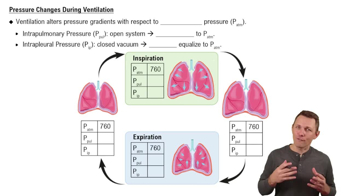
Step 3: Apply Boyle's Law, which states that pressure and volume are inversely related in a closed system. As the thoracic cavity volume increases, the pressure inside the lungs (intrapulmonary pressure) decreases relative to atmospheric pressure, allowing air to flow in (inhalation).
Step 4: Consider the intrapleural pressure, which is the pressure within the pleural cavity. When the thoracic cavity expands, the intrapleural pressure becomes more negative (decreases) to help keep the lungs inflated.
Step 5: Based on these physiological changes, identify which of the given options correctly describe the effects of diaphragm and external intercostal muscle contraction.

Risposta video verificata per un problema simile:

Questa soluzione video è stata consigliata dai nostri tutor come utile per risolvere questo problema.

Concetti chiave

Ecco i concetti essenziali che devi comprendere per rispondere correttamente alla domanda.

Role of the Diaphragm and External Intercostal Muscles in Breathing

The diaphragm and external intercostal muscles are primary muscles involved in inspiration. When they contract, the diaphragm moves downward and the rib cage expands, increasing the thoracic cavity's volume and facilitating air intake into the lungs.
Video consigliato:
4:53
Ventilation Example 3

Intrapulmonary and Intrapleural Pressure Changes

Intrapulmonary pressure is the pressure inside the lungs, which decreases during inspiration to allow air inflow. Intrapleural pressure, the pressure within the pleural cavity, becomes more negative during muscle contraction, helping the lungs expand.
Video consigliato:
8:33
Pressure Changes During Ventilation

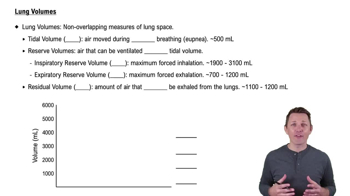
Relationship Between Thoracic Cavity Volume and Lung Volume

The size of the thoracic cavity directly affects lung volume. When the diaphragm and external intercostals contract, the thoracic cavity enlarges, causing lung volume to increase and air to flow in, which is essential for effective breathing.
Video consigliato:
6:28
Lung Volumes