Ch. 23 The Respiratory System
Martini - Fundamentals of Anatomy & Physiology 11th Edition
Martini, Nath, Bartholomew11th EditionFundamentals of Anatomy & PhysiologyISBN: 9780136874089Non è quello che usi tu?Cambia libro di testo
Capitolo 23, Problema 14

Which of the following does not occur in internal respiration?
(a) Oxygen diffuses from the blood to the interstitial spaces.
(b) Carbon dioxide diffuses from the interstitial spaces to the blood.
(c) Hemoglobin binds more oxygen.
(d) Bicarbonate ions are formed in red blood cells.
(e) Chloride ions diffuse into red blood cells as bicarbonate ions diffuse out.

Guida verificata passo dopo passo
1
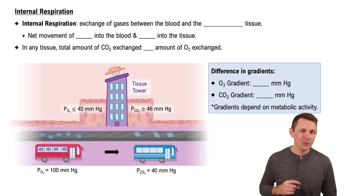
Step 1: Understand the concept of internal respiration. Internal respiration refers to the exchange of gases between the blood in systemic capillaries and the tissue cells. Oxygen moves from the blood to the tissues, and carbon dioxide moves from the tissues to the blood.
Step 2: Analyze option (a): 'Oxygen diffuses from the blood to the interstitial spaces.' This matches the definition of internal respiration, as oxygen leaves the blood to enter tissues.
Step 3: Analyze option (b): 'Carbon dioxide diffuses from the interstitial spaces to the blood.' This also matches internal respiration, where CO2 produced by tissues enters the blood.
Step 4: Analyze option (c): 'Hemoglobin binds more oxygen.' During internal respiration, hemoglobin actually releases oxygen to the tissues, so it does not bind more oxygen at this stage.
Step 5: Analyze options (d) and (e): Both describe processes related to CO2 transport in red blood cells during internal respiration, such as formation of bicarbonate ions and chloride shift, which do occur during internal respiration.

Risposta video verificata per un problema simile:

Questa soluzione video è stata consigliata dai nostri tutor come utile per risolvere questo problema.

Concetti chiave

Ecco i concetti essenziali che devi comprendere per rispondere correttamente alla domanda.

Internal Respiration

Internal respiration refers to the exchange of gases between the blood and the body's tissues. Oxygen diffuses from the blood into the interstitial fluid and then into cells, while carbon dioxide moves from the cells into the blood. This process supports cellular metabolism by supplying oxygen and removing carbon dioxide.
Video consigliato:
5:20
Internal Respiration

Oxygen and Carbon Dioxide Transport in Blood

Oxygen is primarily transported bound to hemoglobin in red blood cells, releasing oxygen to tissues during internal respiration. Carbon dioxide is transported in three forms: dissolved in plasma, bound to hemoglobin, and as bicarbonate ions formed inside red blood cells through the enzyme carbonic anhydrase.
Video consigliato:

Chloride Shift (Hamburger Phenomenon)

The chloride shift is the movement of chloride ions into red blood cells as bicarbonate ions diffuse out into the plasma, maintaining electrical neutrality during carbon dioxide transport. This process mainly occurs in systemic capillaries during internal respiration to facilitate CO2 removal.
Video consigliato:
01:26
Properties of Graded and Action Potentials Example 1