
Ch. 26 The Urinary System
Martini - Fundamentals of Anatomy & Physiology 11th Edition
Martini, Nath, Bartholomew11th EditionFundamentals of Anatomy & PhysiologyISBN: 9780136874089Non è quello che usi tu?Cambia libro di testo
Capitolo 25, Problema 25

Describe the urine voiding reflex.

Guida verificata passo dopo passo
1
Step 1: Understand that the urine voiding reflex, also known as the micturition reflex, is a neural circuit that controls the process of emptying the bladder.
Step 2: Recognize that as the bladder fills with urine, stretch receptors in the bladder wall are activated when the bladder reaches a certain volume.
Step 3: These stretch receptors send afferent signals via the pelvic nerves to the sacral region of the spinal cord (segments S2-S4).
Step 4: The spinal cord processes this sensory information and sends efferent parasympathetic signals back to the detrusor muscle of the bladder, causing it to contract, while simultaneously inhibiting the somatic motor neurons that keep the external urethral sphincter contracted.
Step 5: This coordinated contraction of the detrusor muscle and relaxation of the urethral sphincters allows urine to be expelled from the bladder through the urethra, completing the voiding process.

Risposta video verificata per un problema simile:

Questa soluzione video è stata consigliata dai nostri tutor come utile per risolvere questo problema.

Concetti chiave

Ecco i concetti essenziali che devi comprendere per rispondere correttamente alla domanda.

Micturition Reflex

The micturition reflex is a neural circuit that controls the process of urine voiding. It involves sensory signals from the bladder to the spinal cord and brain, triggering coordinated contraction of the detrusor muscle and relaxation of the urethral sphincters to allow urine expulsion.
Video consigliato:
3:37
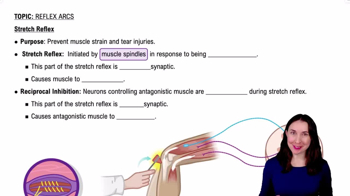
Stretch Reflex

Role of the Autonomic Nervous System

The autonomic nervous system regulates bladder function through sympathetic and parasympathetic pathways. Parasympathetic activation causes detrusor muscle contraction for voiding, while sympathetic activity promotes bladder relaxation and sphincter contraction to store urine.
Video consigliato:
1:50
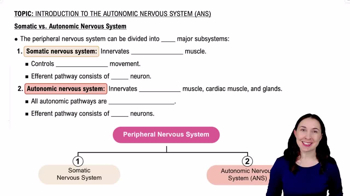
Somatic vs. Autonomic Nervous System

Voluntary Control and Higher Brain Centers

Higher brain centers, including the pontine micturition center and cerebral cortex, provide voluntary control over urination. They coordinate the timing of voiding by inhibiting or facilitating the reflex, allowing conscious decision-making about when to urinate.
Video consigliato:
2:05
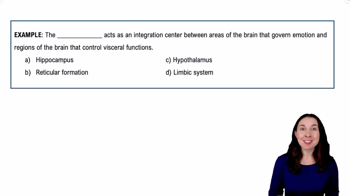
Control of the ANS Example 2
Pratica correlata
Domanda del libro di testo

In a normal kidney, which of the following conditions would cause an increase in the glomerular filtration rate (GFR)? 

(a) Constriction of the afferent arteriole

(b) A decrease in the pressure of the glomerulus

(c) An increase in the capsular hydrostatic pressure

(d) A decrease in the concentration of plasma proteins in the blood

(e) A decrease in the net glomerular filtration process

108
views
Domanda del libro di testo

What interacting controls stabilize the glomerular filtration rate (GFR)?

92
views
Domanda del libro di testo

Sylvia is suffering from severe edema in her arms and legs. Her physician prescribes a diuretic (a substance that increases the volume of urine produced). Why might this help alleviate Sylvia’s problem?

59
views
Domanda del libro di testo

What primary changes occur in the composition and concentration of filtrate as a result of activity in the proximal convoluted tubule?

55
views
Domanda del libro di testo

In response to excess water in the body, 

(a) Antidiuretic hormone is secreted by the anterior lobe of the pituitary gland.

(b) The active transport mechanisms in the ascending thick limb of the nephron loop cease functioning.

(c) The permeability of the distal convoluted tubules and collecting ducts to water is decreased.

(d) The permeability of the ascending limb of the nephron loop is increased.

(e) The glomerular filtration rate is reduced.

53
views
Domanda del libro di testo

Describe two functions of countercurrent multiplication in the kidney.

133
views