
Ch. 26 The Urinary System
Martini - Fundamentals of Anatomy & Physiology 11th Edition
Martini, Nath, Bartholomew11th EditionFundamentals of Anatomy & PhysiologyISBN: 9780136874089Non è quello che usi tu?Cambia libro di testo
Capitolo 25, Problema 23

What primary changes occur in the composition and concentration of filtrate as a result of activity in the proximal convoluted tubule?

Guida verificata passo dopo passo
1
Understand that the proximal convoluted tubule (PCT) is the first segment of the nephron tubule where filtrate from the glomerulus is processed.
Recognize that the PCT reabsorbs a significant portion of the filtrate's components, including about 65-70% of filtered sodium (Na\^+), water, and other solutes like glucose and amino acids.
Note that as sodium ions are actively transported out of the filtrate into the interstitial fluid, water follows passively by osmosis, which decreases the volume of the filtrate but increases the concentration of substances that are not reabsorbed.
Understand that the PCT also secretes certain substances such as hydrogen ions (H\^+) and organic acids into the filtrate, which alters its composition further.
Summarize that the primary changes in the filtrate after the PCT include a large reduction in volume, decreased concentration of reabsorbed solutes (like glucose and amino acids), and increased concentration of non-reabsorbed substances, resulting in a filtrate that is isotonic to plasma.

Risposta video verificata per un problema simile:

Questa soluzione video è stata consigliata dai nostri tutor come utile per risolvere questo problema.

Concetti chiave

Ecco i concetti essenziali che devi comprendere per rispondere correttamente alla domanda.

Proximal Convoluted Tubule Function

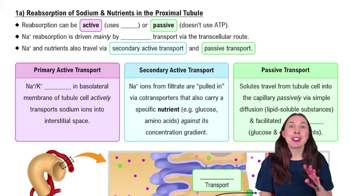
The proximal convoluted tubule (PCT) is the first segment of the nephron tubule where most reabsorption occurs. It actively reabsorbs water, ions, and nutrients like glucose and amino acids from the filtrate back into the bloodstream, significantly reducing filtrate volume and altering its composition.
Video consigliato:
6:51
1a) Reabsorption of Sodium & Nutrients in the Proximal Tubule

Filtrate Composition Changes

As filtrate passes through the PCT, its concentration of essential solutes such as sodium, chloride, glucose, and bicarbonate decreases due to reabsorption. Conversely, waste products like creatinine and urea remain or become more concentrated, changing the filtrate’s overall chemical makeup.
Video consigliato:
03:31
Change in Membrane Potential

Mechanisms of Reabsorption

Reabsorption in the PCT involves active transport, facilitated diffusion, and osmosis. Sodium ions are actively transported out, creating an osmotic gradient that drives water reabsorption. Transport proteins enable glucose and amino acids to move back into the blood, ensuring vital substances are conserved.
Video consigliato:
3:25
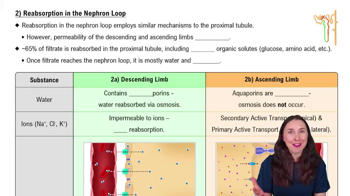
2) Reabsorption in the Nephron Loop