Ch. 6 Bones and Bone Structure
Martini - Fundamentals of Anatomy & Physiology 11th Edition
Martini, Nath, Bartholomew11th EditionFundamentals of Anatomy & PhysiologyISBN: 9780136874089Non è quello che usi tu?Cambia libro di testo
Capitolo 6, Problema 21

Why do extended periods of inactivity cause degenerative changes in the skeleton?

Guida verificata passo dopo passo
1
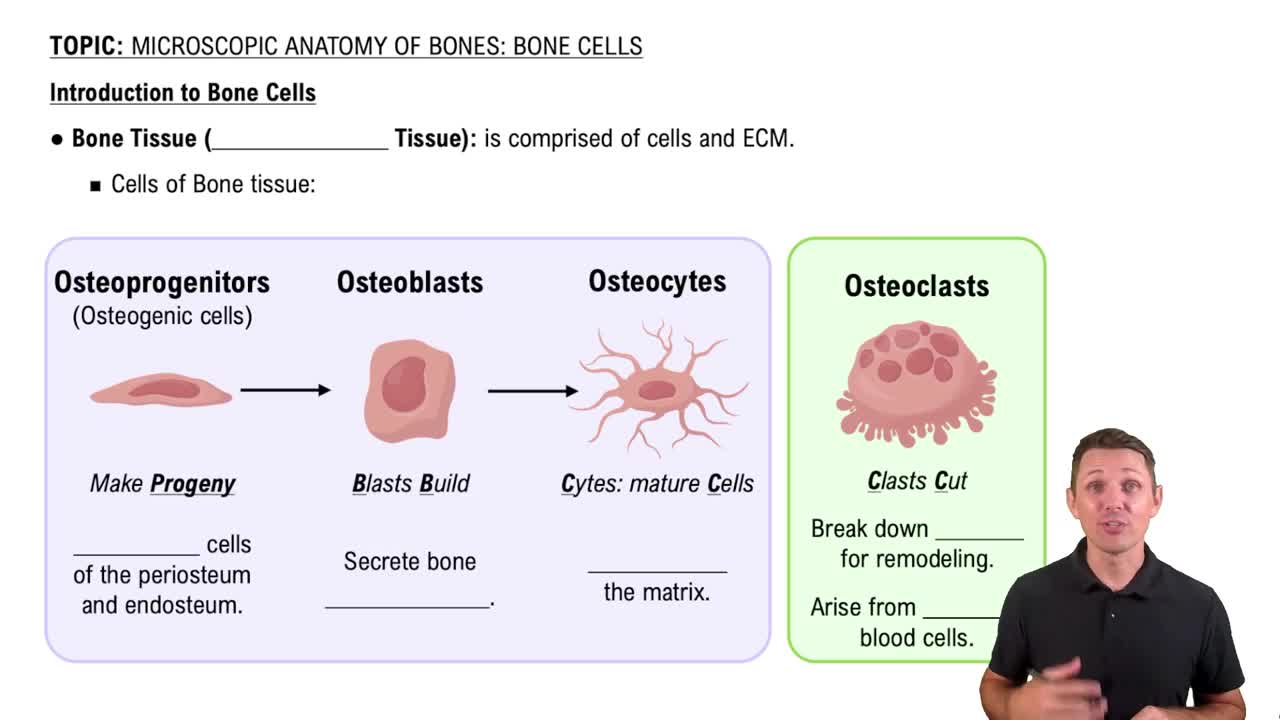
Understand that the skeleton is a dynamic structure that constantly undergoes remodeling through the activities of osteoblasts (bone-building cells) and osteoclasts (bone-resorbing cells).
Recognize that mechanical stress and physical activity stimulate osteoblasts to build and maintain bone density and strength, a principle known as Wolff's Law.
Identify that during extended periods of inactivity, such as bed rest or immobilization, the lack of mechanical stress leads to decreased stimulation of osteoblasts.
Realize that without sufficient mechanical loading, osteoclast activity may outpace osteoblast activity, resulting in increased bone resorption and decreased bone formation.
Conclude that this imbalance causes degenerative changes such as bone loss, decreased bone density (osteopenia or osteoporosis), and weakening of the skeletal structure.

Risposta video verificata per un problema simile:

Questa soluzione video è stata consigliata dai nostri tutor come utile per risolvere questo problema.
Durata del video:
2m

Concetti chiave

Ecco i concetti essenziali che devi comprendere per rispondere correttamente alla domanda.

Bone Remodeling

Bone remodeling is a continuous process where old bone tissue is broken down by osteoclasts and new bone is formed by osteoblasts. This balance maintains bone strength and health. Inactivity disrupts this process, leading to decreased bone formation and increased resorption.
Video consigliato:
4:19
Introduction to Bone Cells

Mechanical Stress and Wolff's Law

Wolff's Law states that bone adapts to the loads under which it is placed. Mechanical stress from physical activity stimulates bone growth and strength. Without regular stress, bones lose density and weaken, causing degenerative changes during inactivity.
Video consigliato:
Percorso guidato
02:52
Second Law of Thermodynamics

Effects of Immobilization on Bone Density

Prolonged inactivity or immobilization reduces the mechanical stimuli necessary for maintaining bone density. This leads to osteoporosis-like conditions where bones become porous and fragile, increasing the risk of fractures and degenerative skeletal changes.
Video consigliato:
Percorso guidato
1:32
Effects of the Complement System