
Ch. 9 - Differential Equations
Briggs - Calculus: Early Transcendentals 3rd Edition
Briggs3rd EditionCalculus: Early TranscendentalsISBN: 9780136847243Non è quello che usi tu?Cambia libro di testo
Capitolo 9, Problema 9.2.33a

33–36. {Use of Tech} Computing Euler approximations Use a calculator or computer program to carry out the following steps.
a. Approximate the value of y(T) using Euler’s method with the given time step on the interval [0,T].


y′(t) = -2y, y(0) = 1; Δt = 0.2, T = 2; y(t) = e⁻²ᵗ

Guida verificata passo dopo passo
1
Identify the differential equation and initial condition: \(y'(t) = -2y\), with \(y(0) = 1\).
Set the time step \(\Delta t = 0.2\) and the interval from \(t=0\) to \(T=2\). Calculate the number of steps as \(n = \frac{T}{\Delta t} = \frac{2}{0.2} = 10\).
Recall Euler's method formula: \(y_{k+1} = y_k + \Delta t \cdot f(t_k, y_k)\), where \(f(t, y) = y'(t) = -2y\).
Start with the initial value \(y_0 = 1\) at \(t_0 = 0\). For each step \(k\) from 0 to 9, compute \(y_{k+1}\) using the formula: \(y_{k+1} = y_k + 0.2 \times (-2 y_k) = y_k - 0.4 y_k = y_k (1 - 0.4)\).
Repeat the calculation iteratively for all steps until you reach \(t = 2\). The final value \(y_{10}\) will be the Euler approximation of \(y(2)\).

Risposta video verificata per un problema simile:

Questa soluzione video è stata consigliata dai nostri tutor come utile per risolvere questo problema.
Durata del video:
10m

Concetti chiave

Ecco i concetti essenziali che devi comprendere per rispondere correttamente alla domanda.

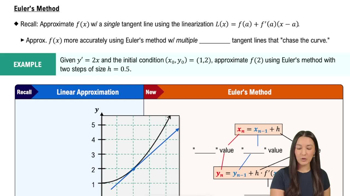
Euler's Method

Euler's method is a numerical technique to approximate solutions of first-order differential equations. It uses a stepwise approach, updating the solution by moving along the slope given by the differential equation at each step. This method is especially useful when an exact solution is difficult to find.
Video consigliato:
07:33
Euler's Method

Initial Value Problems (IVP)

An initial value problem specifies the value of the solution at a starting point, allowing the differential equation to be solved uniquely. Here, y(0) = 1 sets the initial condition, which is essential for applying Euler's method to approximate y(t) over the interval.
Video consigliato:
Percorso guidato
05:03
Initial Value Problems

Step Size and Interval in Numerical Methods

The step size (Δt) determines the increments at which the solution is approximated, affecting accuracy and computational effort. The interval [0, T] defines the domain over which the solution is computed. Smaller step sizes generally yield more accurate results but require more calculations.
Video consigliato:
08:09
Euler's Method Example 1
Pratica correlata
Domanda del libro di testo

43–44. Motion in a gravitational field: An object is fired vertically upward with initial velocity v(0)=v₀ from initial position s(0)=s₀.

a. For the following values of v₀ and s₀, find the position and velocity functions for all times at which the object is above the ground (s = 0).

v₀ = 49 m/s, s₀ = 60 m

52
views
Domanda del libro di testo

Explain why or why not Determine whether the following statements are true and give an explanation or counterexample.

a. The general solution of the differential equation y'(t) = 1 is y(t) = t

38
views
Domanda del libro di testo

[Use of Tech] Analysis of a separable equation Consider the differential equation yy'(t) = ½eᵗ + t and carry out the following analysis.

a. Find the general solution of the equation and express it explicitly as a function of t in two cases: y > 0 and y < 0.

44
views
Domanda del libro di testo

{Use of Tech} Torricelli’s law An open cylindrical tank initially filled with water drains through a hole in the bottom of the tank according to Torricelli’s law (see figure). If h(t) is the depth of water in the tank for t≥0 s, then Torricelli’s law implies h′(t)=−k√h, where k is a constant that includes g=9.8m/s², the radius of the tank, and the radius of the drain. Assume the initial depth of the water is h(0)=Hm. 

a. Find the solution of the initial value problem.

84
views
Domanda del libro di testo

17–20. Increasing and decreasing solutions Consider the following differential equations. A detailed direction field is not needed.


a. Find the solutions that are constant, for all t ≥ 0 (the equilibrium solutions).


y'(t) = (y−2)(y+1)

50
views
Domanda del libro di testo

42–43. Implicit solutions for separable equations For the following separable equations, carry out the indicated analysis.

a. Find the general solution of the equation.


e⁻ʸᐟ²y'(x) = 4x sin x² − x; y(0) = 0, y(0) = ln(1/4), y(√(π/2)) = 0


42
views