Ch. 9 - Differential Equations
Briggs - Calculus: Early Transcendentals 3rd Edition
Briggs3rd EditionCalculus: Early TranscendentalsISBN: 9780136847243Non è quello che usi tu?Cambia libro di testo
Capitolo 9, Problema 9.3.54a

[Use of Tech] Analysis of a separable equation Consider the differential equation yy'(t) = ½eᵗ + t and carry out the following analysis.
a. Find the general solution of the equation and express it explicitly as a function of t in two cases: y > 0 and y < 0.

Guida verificata passo dopo passo
1
Rewrite the given differential equation \(y y'(t) = \frac{1}{2} e^{t} + t\) by recognizing that \(y'(t) = \frac{dy}{dt}\). This gives \(y \frac{dy}{dt} = \frac{1}{2} e^{t} + t\).
Separate variables by multiplying both sides by \(dt\) and dividing both sides by \(y\): \(y \, dy = \left( \frac{1}{2} e^{t} + t \right) dt\).
Integrate both sides: \(\int y \, dy = \int \left( \frac{1}{2} e^{t} + t \right) dt\). This will give you an implicit relation between \(y\) and \(t\).
Compute the integrals separately: \(\int y \, dy = \frac{y^{2}}{2} + C_1\) and \(\int \left( \frac{1}{2} e^{t} + t \right) dt = \frac{1}{2} e^{t} + \frac{t^{2}}{2} + C_2\). Combine constants into a single constant \(C\).
Solve for \(y\) explicitly by multiplying both sides by 2 and taking the square root: \(y = \pm \sqrt{e^{t} + t^{2} + C}\). Then express the general solution separately for \(y > 0\) and \(y < 0\) as \(y = +\sqrt{e^{t} + t^{2} + C}\) and \(y = -\sqrt{e^{t} + t^{2} + C}\) respectively.

Risposta video verificata per un problema simile:

Questa soluzione video è stata consigliata dai nostri tutor come utile per risolvere questo problema.
Durata del video:
3m

Concetti chiave

Ecco i concetti essenziali che devi comprendere per rispondere correttamente alla domanda.

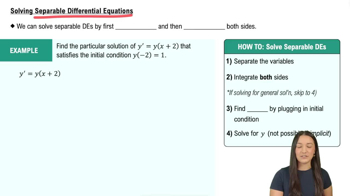
Separable Differential Equations

A separable differential equation can be written as a product of a function of y and a function of t, allowing variables to be separated on opposite sides of the equation. This enables integration with respect to each variable independently to find the general solution.
Video consigliato:
06:06
Solving Separable Differential Equations

Integration of Both Sides

After separating variables, integrating both sides is essential to solve for y explicitly. This involves integrating functions of t on one side and functions of y on the other, often requiring techniques like substitution or recognizing standard integral forms.
Video consigliato:
05:50
One-Sided Limits

Handling Absolute Values and Sign Cases

When solving for y explicitly, the solution may involve absolute values due to integration of terms like 1/y. Distinguishing cases y > 0 and y < 0 ensures correct interpretation of the solution and avoids ambiguity in the sign of y.
Video consigliato:
Percorso guidato
05:59
Initial Value Problems Example 2
Pratica correlata
Domanda del libro di testo

Explain why or why not Determine whether the following statements are true and give an explanation or counterexample.

a. The general solution of the differential equation y'(t) = 1 is y(t) = t

38
views

Domanda del libro di testo

17–20. Increasing and decreasing solutions Consider the following differential equations. A detailed direction field is not needed.


a. Find the solutions that are constant, for all t ≥ 0 (the equilibrium solutions).


y'(t) = (y−2)(y+1)

50
views
Domanda del libro di testo

33–36. {Use of Tech} Computing Euler approximations Use a calculator or computer program to carry out the following steps.

a. Approximate the value of y(T) using Euler’s method with the given time step on the interval [0,T].


y′(t) = -2y, y(0) = 1; Δt = 0.2, T = 2; y(t) = e⁻²ᵗ

61
views
Domanda del libro di testo

38–43. Equilibrium solutions A differential equation of the form y′(t)=f(y) is said to be autonomous (the function f depends only on y). The constant function y=y0 is an equilibrium solution of the equation provided f(y0)=0 (because then y'(t)=0 and the solution remains constant for all t). Note that equilibrium solutions correspond to horizontal lines in the direction field. Note also that for autonomous equations, the direction field is independent of t. Carry out the following analysis on the given equations.

a. Find the equilibrium solutions.


y′(t) = 2y + 4

73
views
Domanda del libro di testo

46–48. Analyzing models The following models were discussed in Section 9.1 and reappear in later sections of this chapter. In each case, carry out the indicated analysis using direction fields.

Drug infusion The delivery of a drug (such as an antibiotic) through an intravenous line may be modeled by the differential equation m′(t)+km(t)=I, where m(t) is the mass of the drug in the blood at time t≥0, K is a constant that describes the rate at which the drug is absorbed, and I is the infusion rate. Let I=10mg/hr and k=0.05 hr^−1.

a. Draw the direction field, for 0≤t≤100, 0≤y≤600.

42
views
Domanda del libro di testo

Consider the differential equation y'(t)+9y(t)=10.

a. How many arbitrary constants appear in the general solution of the differential equation?

56
views