
Ch.12 - Parametric and Polar Curves
Briggs - Calculus: Early Transcendentals 3rd Edition
Briggs3rd EditionCalculus: Early TranscendentalsISBN: 9780136847243Non è quello che usi tu?Cambia libro di testo
Capitolo 12, Problema 12.3.80a

Area of roses Assume m is a positive integer.


a. Even number of leaves: What is the relationship between the total area enclosed by the 4m-leaf rose r=cos(2mθ) and m?

Guida verificata passo dopo passo
1
Recall that the polar equation of a rose curve is given by \(r = \cos(k\theta)\), where \(k\) determines the number of petals (or leaves) of the rose. For \(k = 2m\), the rose has \$4m$ leaves because when $k$ is even, the number of petals is \$2k$.
The area of one petal of a rose curve \(r = \cos(k\theta)\) can be found using the formula for the area in polar coordinates: \(A = \frac{1}{2} \int_{\alpha}^{\beta} r^2 \, d\theta\). Here, \(r^2 = \cos^2(k\theta)\).
To find the total area enclosed by the \$4m$-leaf rose, calculate the area of one petal and then multiply by the total number of petals, which is \$4m$.
Determine the limits of integration for one petal. Since the rose has \$4m$ petals evenly distributed over \(2\pi\), the angle for one petal is \(\frac{2\pi}{4m} = \frac{\pi}{2m}\). So, integrate \(\theta\) from \(0\) to \(\frac{\pi}{2m}\) for one petal.
Set up the integral for the area of one petal: \(A_{petal} = \frac{1}{2} \int_0^{\frac{\pi}{2m}} \cos^2(2m\theta) \, d\theta\). Then multiply by \$4m$ to get the total area: \(A_{total} = 4m \times A_{petal}\). Use trigonometric identities to simplify the integral if needed.

Risposta video verificata per un problema simile:

Questa soluzione video è stata consigliata dai nostri tutor come utile per risolvere questo problema.
Durata del video:
5m

Concetti chiave

Ecco i concetti essenziali che devi comprendere per rispondere correttamente alla domanda.

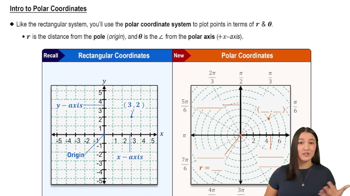
Polar Coordinates and Graphing

Polar coordinates represent points using a radius and angle, ideal for curves like roses. The equation r = cos(kθ) produces rose curves with petals depending on k. Understanding how to plot and interpret these curves is essential for analyzing their geometric properties.
Video consigliato:
05:32
Intro to Polar Coordinates

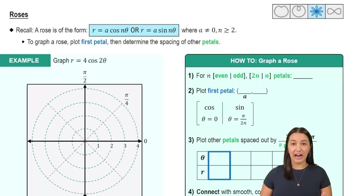
Rose Curves and Petal Count

Rose curves defined by r = cos(kθ) have petals determined by k: if k is even, the curve has 2k petals; if odd, k petals. For r = cos(2mθ), with m positive integer, the curve has 4m petals. Recognizing this helps relate the number of petals to the parameter m.
Video consigliato:
3:37
Roses

Area Calculation in Polar Coordinates

The area enclosed by a polar curve r(θ) from θ = a to b is given by (1/2)∫[a to b] (r(θ))^2 dθ. For rose curves, integrating over one petal and multiplying by the number of petals yields total area. This integral approach is key to finding the relationship between area and m.
Video consigliato:
05:32
Intro to Polar Coordinates
Pratica correlata
Domanda del libro di testo

11–14. Working with parametric equations Consider the following parametric equations.

a. Make a brief table of values of t, x, and y.

b. Plot the (x, y) pairs in the table and the complete parametric curve, indicating the positive orientation (the direction of increasing t).


x=−t+6, y=3t−3; −5≤t≤5 

69
views
Domanda del libro di testo

11–14. Working with parametric equations Consider the following parametric equations.

a. Make a brief table of values of t, x, and y.

b. Plot the (x, y) pairs in the table and the complete parametric curve, indicating the positive orientation (the direction of increasing t).


x=2 t,y=3t−4;−10≤d≤10 

52
views
Domanda del libro di testo

The ellipse and the parabola: Let R be the region bounded by the upper half of the ellipse x²/2 + y² = 1 and the parabola y = x²/√2

a. Find the area of R

105
views
Domanda del libro di testo

Reflection property of parabolas: Consider the parabola y = x²/(4p) with its focus at F(0, p). The goal is to show that the angle of incidence (α) equals the angle of reflection (β).

a. Let P(x₀, y₀) be a point on the parabola. Show that the slope of the tangent line at P is tan θ = x₀/(2p).

296
views
Domanda del libro di testo

Explain why or why not Determine whether the following statements are true and give an explanation or counterexample.  


a. The point with Cartesian coordinates (−2, 2) has polar coordinates (2√2, 3π/4), (2√2, 11π/4), (2√2, −5π/4), and (−2√2,−π/4).  

40
views
Domanda del libro di testo

67–72. Derivatives Consider the following parametric curves.

a. Determine dy/dx in terms of t and evaluate it at the given value of t.


x = t + 1/t, y = t − 1/t; t = 1

67
views