
Ch.12 - Parametric and Polar Curves
Briggs - Calculus: Early Transcendentals 3rd Edition
Briggs3rd EditionCalculus: Early TranscendentalsISBN: 9780136847243Non è quello che usi tu?Cambia libro di testo
Capitolo 12, Problema 12.2.77a

Explain why or why not Determine whether the following statements are true and give an explanation or counterexample.  


a. The point with Cartesian coordinates (−2, 2) has polar coordinates (2√2, 3π/4), (2√2, 11π/4), (2√2, −5π/4), and (−2√2,−π/4).  

Guida verificata passo dopo passo
1
Recall the relationship between Cartesian coordinates \((x, y)\) and polar coordinates \((r, \theta)\): \(x = r \cos(\theta)\) and \(y = r \sin(\theta)\), where \(r = \sqrt{x^2 + y^2}\) and \(\theta = \arctan\left(\frac{y}{x}\right)\) (adjusted for the correct quadrant).
Calculate the radius \(r\) for the point \((-2, 2)\): \(r = \sqrt{(-2)^2 + 2^2} = \sqrt{4 + 4} = \sqrt{8} = 2\sqrt{2}\).
Determine the angle \(\theta\): Since \(x = -2\) and \(y = 2\), the point lies in the second quadrant. The reference angle is \(\arctan\left(\frac{2}{-2}\right) = \arctan(-1)\), but we must add \(\pi\) to get the correct angle in the second quadrant, so \(\theta = \pi - \frac{\pi}{4} = \frac{3\pi}{4}\).
Check each given polar coordinate to see if it corresponds to the Cartesian point \((-2, 2)\) by converting back to Cartesian using \(x = r \cos(\theta)\) and \(y = r \sin(\theta)\):
- For \((2\sqrt{2}, \frac{3\pi}{4})\), verify if \(x = 2\sqrt{2} \cos(\frac{3\pi}{4})\) and \(y = 2\sqrt{2} \sin(\frac{3\pi}{4})\) equal \((-2, 2)\).
- Repeat this for \((2\sqrt{2}, \frac{11\pi}{4})\), \((2\sqrt{2}, -\frac{5\pi}{4})\), and \((-2\sqrt{2}, -\frac{\pi}{4})\).
Remember that polar coordinates are not unique: adding or subtracting multiples of \(2\pi\) to \(\theta\) gives the same point, and using a negative \(r\) with \(\theta\) shifted by \(\pi\) also represents the same point. Use these facts to explain which of the given coordinates are valid representations of \((-2, 2)\).

Risposta video verificata per un problema simile:

Questa soluzione video è stata consigliata dai nostri tutor come utile per risolvere questo problema.
Durata del video:
3m

Concetti chiave

Ecco i concetti essenziali che devi comprendere per rispondere correttamente alla domanda.

Conversion between Cartesian and Polar Coordinates

This concept involves translating a point from Cartesian coordinates (x, y) to polar coordinates (r, θ), where r is the distance from the origin and θ is the angle from the positive x-axis. The formulas are r = √(x² + y²) and θ = arctan(y/x), adjusted for the correct quadrant.
Video consigliato:
05:32
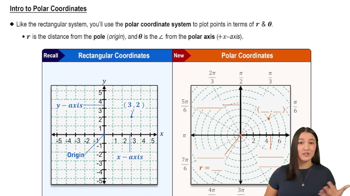
Intro to Polar Coordinates

Multiple Representations of Polar Coordinates

A single point can have infinitely many polar coordinates because adding or subtracting multiples of 2π to the angle θ results in the same direction. Also, negative radius values with adjusted angles can represent the same point, reflecting the non-uniqueness of polar coordinates.
Video consigliato:
05:32
Intro to Polar Coordinates

Quadrant Considerations in Angle Determination

When converting to polar form, the angle θ must be placed in the correct quadrant based on the signs of x and y. This ensures the angle accurately represents the point's direction, as arctan alone only gives values between -π/2 and π/2.
Video consigliato:
5:30
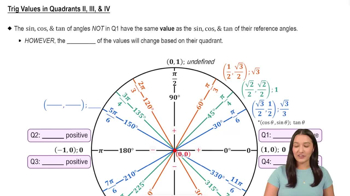
Trig Values in Quadrants II, III, & IV
Pratica correlata
Domanda del libro di testo

11–14. Working with parametric equations Consider the following parametric equations.

a. Make a brief table of values of t, x, and y.

b. Plot the (x, y) pairs in the table and the complete parametric curve, indicating the positive orientation (the direction of increasing t).


x=−t+6, y=3t−3; −5≤t≤5 

69
views
Domanda del libro di testo

11–14. Working with parametric equations Consider the following parametric equations.

a. Make a brief table of values of t, x, and y.

b. Plot the (x, y) pairs in the table and the complete parametric curve, indicating the positive orientation (the direction of increasing t).


x=2 t,y=3t−4;−10≤d≤10 

52
views
Domanda del libro di testo

Area of roses Assume m is a positive integer.


a. Even number of leaves: What is the relationship between the total area enclosed by the 4m-leaf rose r=cos(2mθ) and m?

26
views
Domanda del libro di testo

Reflection property of parabolas: Consider the parabola y = x²/(4p) with its focus at F(0, p). The goal is to show that the angle of incidence (α) equals the angle of reflection (β).

a. Let P(x₀, y₀) be a point on the parabola. Show that the slope of the tangent line at P is tan θ = x₀/(2p).

296
views
Domanda del libro di testo

67–72. Derivatives Consider the following parametric curves.

a. Determine dy/dx in terms of t and evaluate it at the given value of t.


x = t + 1/t, y = t − 1/t; t = 1

67
views
Domanda del libro di testo

(Use of Tech) Finger curves: r = f(θ) = cos(aᶿ) - 1.5, where a = (1 + 12π)^(1/(2π)) ≈ 1.78933

a. Show that f(0) = f(2π) and find the point on the curve that corresponds to θ = 0 and θ = 2π.

54
views