Ch. 2 - Limits and Continuity
Hass - Thomas' Calculus 15th Edition
Hass15th EditionThomas' CalculusISBN: 9780137616077Non è quello che usi tu?Cambia libro di testo
Capitolo 2, Problema 2.25

Finding Limits


In Exercises 25–28, find the limit of g(x) as x approaches the indicated value.


lim (4g(x))¹/³ = 2
x →0

Guida verificata passo dopo passo
1
First, understand the problem: We need to find the limit of the function (4g(x))^(1/3) as x approaches 0, and we know that this limit equals 2.
To solve this, we can start by setting up the equation based on the given limit: lim (4g(x))^(1/3) = 2 as x → 0.
Next, cube both sides of the equation to eliminate the cube root. This gives us: lim 4g(x) = 2^3 = 8 as x → 0.
Now, solve for g(x) by dividing both sides of the equation by 4: lim g(x) = 8/4 = 2 as x → 0.
Finally, verify that the limit of g(x) as x approaches 0 is indeed 2, which satisfies the original condition of the problem.

Risposta video verificata per un problema simile:

Questa soluzione video è stata consigliata dai nostri tutor come utile per risolvere questo problema.
Durata del video:
2m

Concetti chiave

Ecco i concetti essenziali che devi comprendere per rispondere correttamente alla domanda.

Limits

A limit is a fundamental concept in calculus that describes the behavior of a function as its input approaches a certain value. It helps in understanding how functions behave near specific points, which is crucial for defining continuity and derivatives. In this case, we are interested in the limit of the function g(x) as x approaches 0.
Video consigliato:
05:50
One-Sided Limits

Continuous Functions

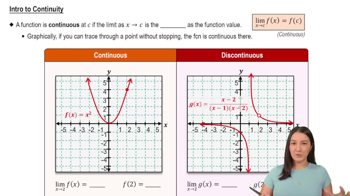
A function is continuous at a point if the limit of the function as it approaches that point equals the function's value at that point. This concept is essential when evaluating limits, as it allows us to substitute values directly into the function if it is continuous. If g(x) is continuous at x = 0, we can directly evaluate the limit without any complications.
Video consigliato:
05:34
Intro to Continuity

Cube Root Function

The cube root function, denoted as (4g(x))^(1/3), is a transformation of the function g(x) that involves taking the cube root of the product of 4 and g(x). Understanding how this function behaves as x approaches 0 is key to solving the limit problem. The limit provided indicates that as x approaches 0, the cube root of 4g(x) approaches 2, which can help us find the value of g(0).
Video consigliato:
Percorso guidato
5:57
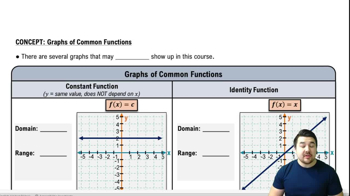
Graphs of Common Functions