Ch. 2 - Limits and Continuity
Hass - Thomas' Calculus 15th Edition
Hass15th EditionThomas' CalculusISBN: 9780137616077Non è quello che usi tu?Cambia libro di testo
Capitolo 2, Problema 2.2.49

Limits with trigonometric functions


Find the limits in Exercises 43–50.


limx→−π √(x + 4) cos(x + π)

Guida verificata passo dopo passo
1
First, understand the problem: We need to find the limit of the function \( \sqrt{x + 4} \cos(x + \pi) \) as \( x \) approaches \( -\pi \).
Substitute \( x = -\pi \) into the expression \( \sqrt{x + 4} \). This gives \( \sqrt{-\pi + 4} \). Calculate \( -\pi + 4 \) to find the value inside the square root.
Next, substitute \( x = -\pi \) into the expression \( \cos(x + \pi) \). This simplifies to \( \cos(-\pi + \pi) = \cos(0) \). Recall that \( \cos(0) = 1 \).
Combine the results from the previous steps: The limit expression becomes \( \sqrt{-\pi + 4} \times 1 \).
Evaluate \( \sqrt{-\pi + 4} \) to find the final limit value. Ensure that the expression inside the square root is non-negative, as the square root function is defined for non-negative values.

Risposta video verificata per un problema simile:

Questa soluzione video è stata consigliata dai nostri tutor come utile per risolvere questo problema.
Durata del video:
1m

Concetti chiave

Ecco i concetti essenziali che devi comprendere per rispondere correttamente alla domanda.

Limits

Limits are fundamental in calculus, representing the value that a function approaches as the input approaches a certain point. They are essential for understanding continuity, derivatives, and integrals. In this context, evaluating the limit as x approaches -π involves determining the behavior of the function near that point.
Video consigliato:
05:50
One-Sided Limits

Trigonometric Functions

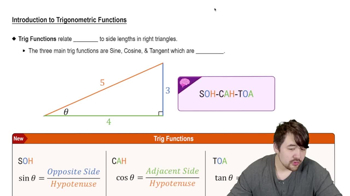
Trigonometric functions, such as cosine, are periodic functions that relate angles to ratios of sides in right triangles. They play a crucial role in calculus, especially when dealing with limits, derivatives, and integrals involving angles. Understanding how these functions behave near specific points is key to solving limit problems.
Video consigliato:
Percorso guidato
6:04
Introduction to Trigonometric Functions

Square Root Function

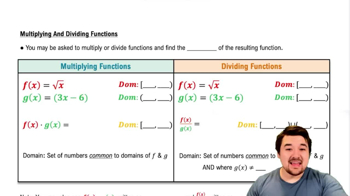
The square root function, denoted as √(x), is defined for non-negative values of x and represents the principal square root. In limit problems, it is important to consider the domain of the function and how it behaves as the input approaches certain values. In this case, √(x + 4) must be evaluated as x approaches -π to ensure the expression remains valid.
Video consigliato:
Percorso guidato
7:24
Multiplying & Dividing Functions