Ch. 1 - Equations and Inequalities
Blitzer - College Algebra 8th Edition
Blitzer8th EditionCollege AlgebraISBN: 9780136970514Non è quello che usi tu?Cambia libro di testo
Capitolo 2, Problema 75a

Exercises 73–75 will help you prepare for the material covered in the next section. Rationalize the denominator: (7 + 4√2)/(2 - 5√2).

Guida verificata passo dopo passo
1
Identify the problem: The goal is to rationalize the denominator of the given expression \((7 + 4\sqrt{2}) / (2 - 5\sqrt{2})\). This means eliminating the square root from the denominator by multiplying both numerator and denominator by the conjugate of the denominator.
Determine the conjugate of the denominator: The conjugate of \(2 - 5\sqrt{2}\) is \(2 + 5\sqrt{2}\). Multiplying by the conjugate will use the difference of squares formula \((a - b)(a + b) = a^2 - b^2\) to eliminate the square root.
Multiply both numerator and denominator by the conjugate: Multiply \((7 + 4\sqrt{2})\) by \((2 + 5\sqrt{2})\) in the numerator, and \((2 - 5\sqrt{2})\) by \((2 + 5\sqrt{2})\) in the denominator. This ensures the value of the expression remains unchanged.
Simplify the denominator: Use the difference of squares formula \((a - b)(a + b) = a^2 - b^2\) to simplify \((2 - 5\sqrt{2})(2 + 5\sqrt{2})\). This will result in \(2^2 - (5\sqrt{2})^2\).
Simplify the numerator: Expand \((7 + 4\sqrt{2})(2 + 5\sqrt{2})\) using the distributive property (FOIL method). Combine like terms, ensuring to simplify any terms involving \(\sqrt{2}\). After simplifying both numerator and denominator, the expression will be rationalized.

Risposta video verificata per un problema simile:

Questa soluzione video è stata consigliata dai nostri tutor come utile per risolvere questo problema.
Durata del video:
3m

Concetti chiave

Ecco i concetti essenziali che devi comprendere per rispondere correttamente alla domanda.

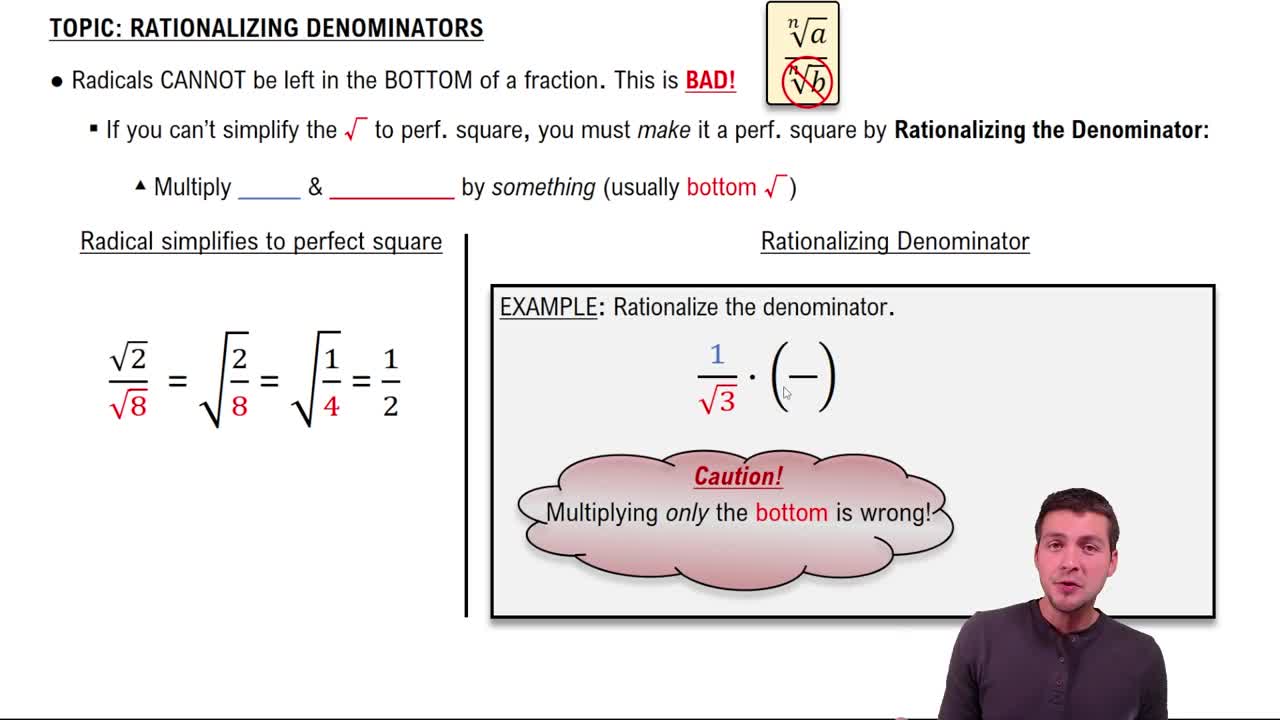
Rationalizing the Denominator

Rationalizing the denominator involves eliminating any irrational numbers from the denominator of a fraction. This is typically achieved by multiplying both the numerator and the denominator by a suitable expression that will result in a rational number in the denominator. For example, if the denominator contains a square root, multiplying by the conjugate can help achieve this.
Video consigliato:
02:58
Rationalizing Denominators

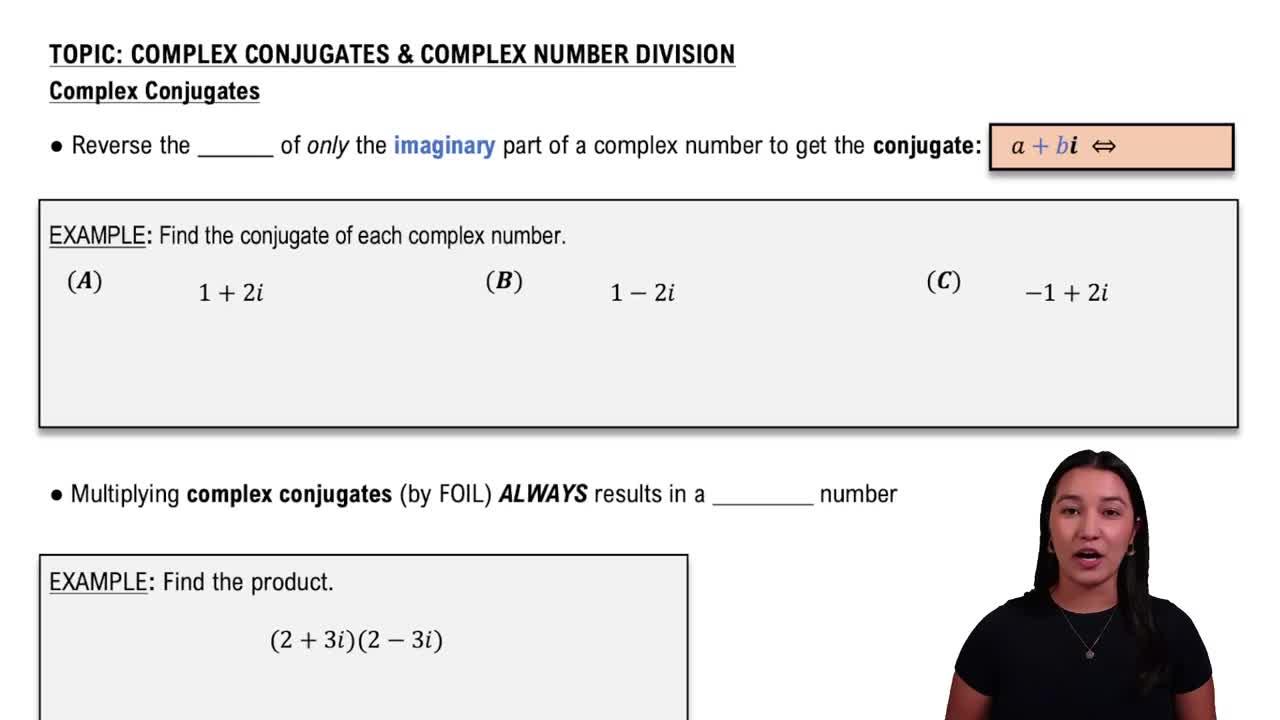
Conjugates

The conjugate of a binomial expression is formed by changing the sign of the second term. For instance, the conjugate of (a + b) is (a - b). When multiplying a binomial by its conjugate, the result is a difference of squares, which eliminates the square root in the denominator, making it easier to rationalize.
Video consigliato:
05:33
Complex Conjugates

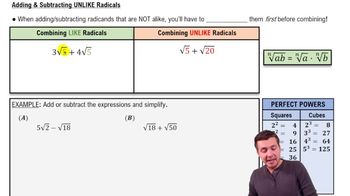
Simplifying Radicals

Simplifying radicals involves reducing a square root or other root to its simplest form. This can include factoring out perfect squares from under the radical sign or rewriting the expression in a way that minimizes the radical's complexity. Understanding how to simplify radicals is essential for effectively rationalizing denominators and simplifying expressions.
Video consigliato:
5:48
Adding & Subtracting Unlike Radicals by Simplifying