In Exercises 59–94, solve each absolute value inequality. |3 - (2/3)x| > 5
Ch. 1 - Equations and Inequalities

Capitolo 2, Problema 76a
In Exercises 71–78, solve each equation. Then determine whether the equation is an identity, a conditional equation, or an inconsistent equation. 5x + 7 = 2x + 7
Guida verificata passo dopo passo1
Start by isolating the variable term on one side of the equation. Subtract 2x from both sides of the equation: .
Simplify the equation by combining like terms: , which simplifies to .
Next, isolate the term with the variable by subtracting 7 from both sides: .
Simplify the equation further: .
Finally, solve for by dividing both sides of the equation by 3: . After solving, determine whether the equation is an identity, a conditional equation, or an inconsistent equation based on the solution.

Risposta video verificata per un problema simile:
Questa soluzione video è stata consigliata dai nostri tutor come utile per risolvere questo problema.
Durata del video:
1mConcetti chiave
Ecco i concetti essenziali che devi comprendere per rispondere correttamente alla domanda.
Types of Equations
In algebra, equations can be classified into three main types: identities, conditional equations, and inconsistent equations. An identity is true for all values of the variable, a conditional equation is true for specific values, and an inconsistent equation has no solutions. Understanding these classifications helps in determining the nature of the solution set for any given equation.
Video consigliato:
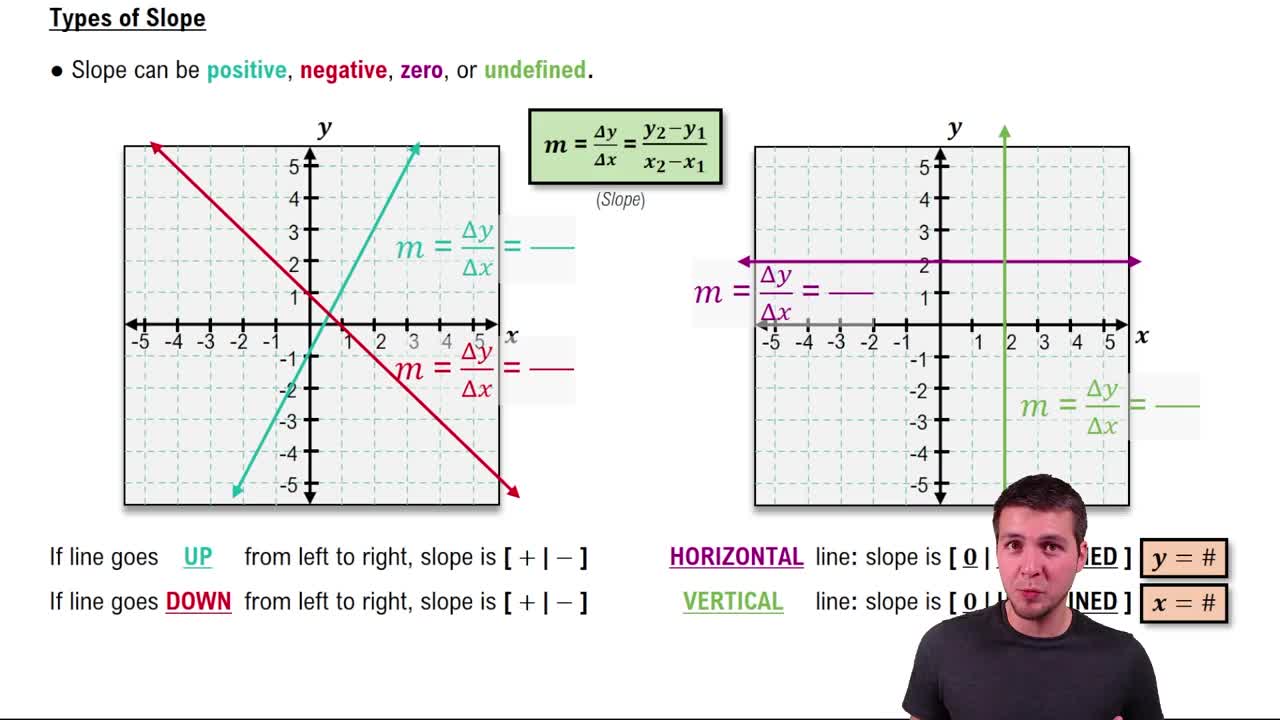
Types of Slope
Solving Linear Equations
Solving linear equations involves isolating the variable to find its value. This typically includes combining like terms, using inverse operations, and simplifying both sides of the equation. For the equation 5x + 7 = 2x + 7, one would rearrange the terms to isolate x, which is essential for determining the type of equation it represents.
Video consigliato:
Solving Linear Equations with Fractions
Checking Solutions
After solving an equation, it is crucial to check the solution by substituting it back into the original equation. This verification process confirms whether the solution is valid and helps identify the type of equation. For instance, if the left-hand side equals the right-hand side after substitution, it indicates whether the equation is an identity or a conditional equation.
Video consigliato:
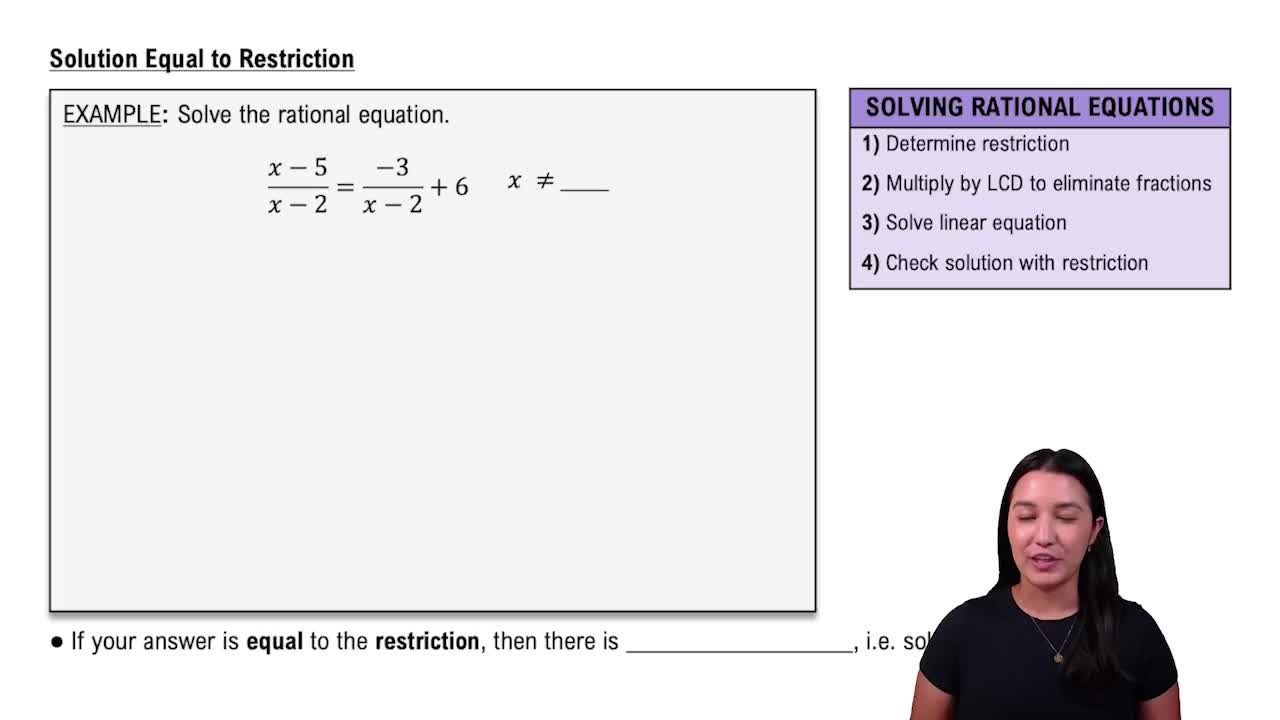
Restrictions on Rational Equations
Pratica correlata
Domanda del libro di testo
970
views
Domanda del libro di testo
Exercises 73–75 will help you prepare for the material covered in the next section. Rationalize the denominator: (7 + 4√2)/(2 - 5√2).
1005
views
Domanda del libro di testo
In Exercises 75–82, compute the discriminant. Then determine the number and type of solutions for the given equation.
909
views
Domanda del libro di testo
The rule for rewriting an absolute value equation without absolute value bars can be extended to equations with two sets of absolute value bars: If u and v represent algebraic expressions, then |u| = |v| is equivalent to u = v or u = - v. Use this to solve the equations in Exercises 77–84. |3x - 1| = |x + 5|
719
views
Domanda del libro di testo
Solve each equation by the method of your choice.
809
views
Domanda del libro di testo
In Exercises 75–82, compute the discriminant. Then determine the number and type of solutions for the given equation.
1462
views