Ch. 1 - Equations and Inequalities
Blitzer - College Algebra 8th Edition
Blitzer8th EditionCollege AlgebraISBN: 9780136970514Non è quello che usi tu?Cambia libro di testo
Capitolo 2, Problema 72

Without solving the given quadratic equation, determine the number and type of solutions. 9x2=2−3x9x^2 = 2-3x

Guida verificata passo dopo passo
1
Rewrite the given quadratic equation in standard form $ax^2 + bx + c = 0$. Start by moving all terms to one side: \(9x^2 + 3x - 2 = 0\).
Identify the coefficients: \(a = 9\), \(b = 3\), and \(c = -2\).
Calculate the discriminant using the formula \(\Delta = b^2 - 4ac\).
Substitute the values into the discriminant formula: \(\Delta = (3)^2 - 4(9)(-2)\).
Analyze the discriminant value: if \(\Delta > 0\), there are two distinct real solutions; if \(\Delta = 0\), there is one real repeated solution; if \(\Delta < 0\), there are two complex solutions.

Risposta video verificata per un problema simile:

Questa soluzione video è stata consigliata dai nostri tutor come utile per risolvere questo problema.
Durata del video:
3m

Concetti chiave

Ecco i concetti essenziali che devi comprendere per rispondere correttamente alla domanda.

Standard Form of a Quadratic Equation

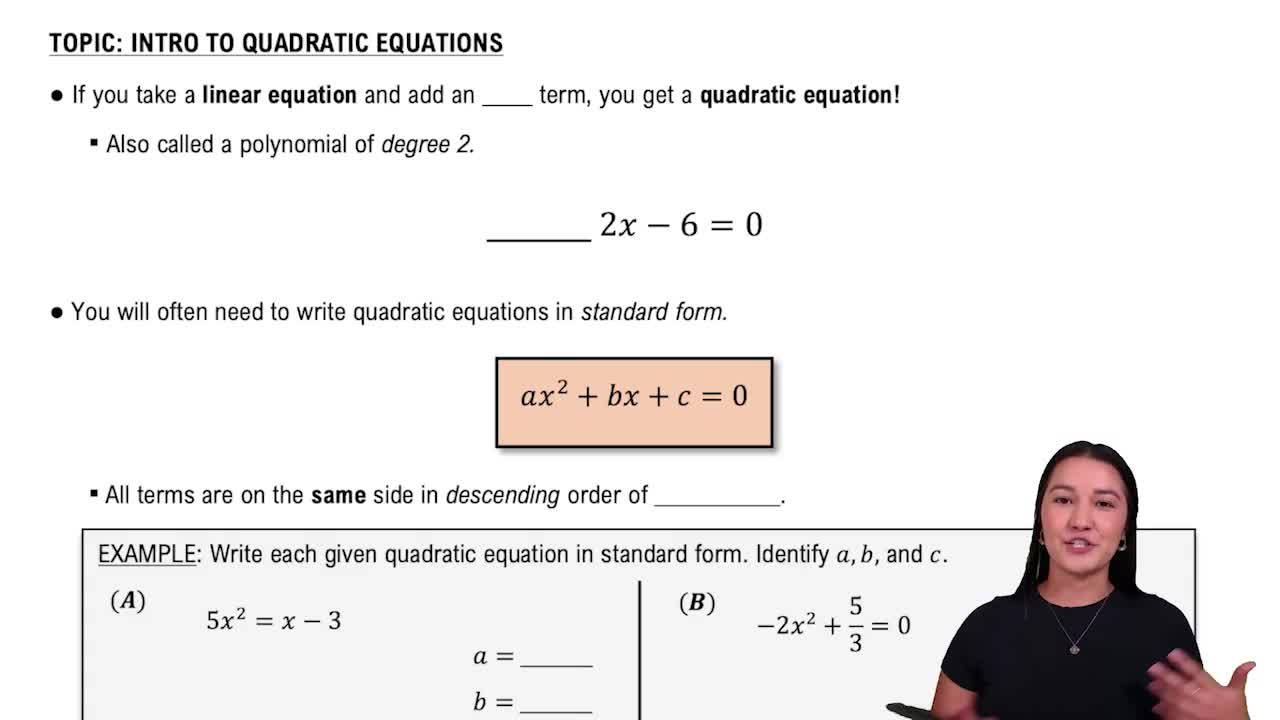
A quadratic equation is typically written in the form ax² + bx + c = 0, where a, b, and c are constants. Converting the given equation into this form is essential for analyzing its properties, such as the number and type of solutions.
Video consigliato:
04:34
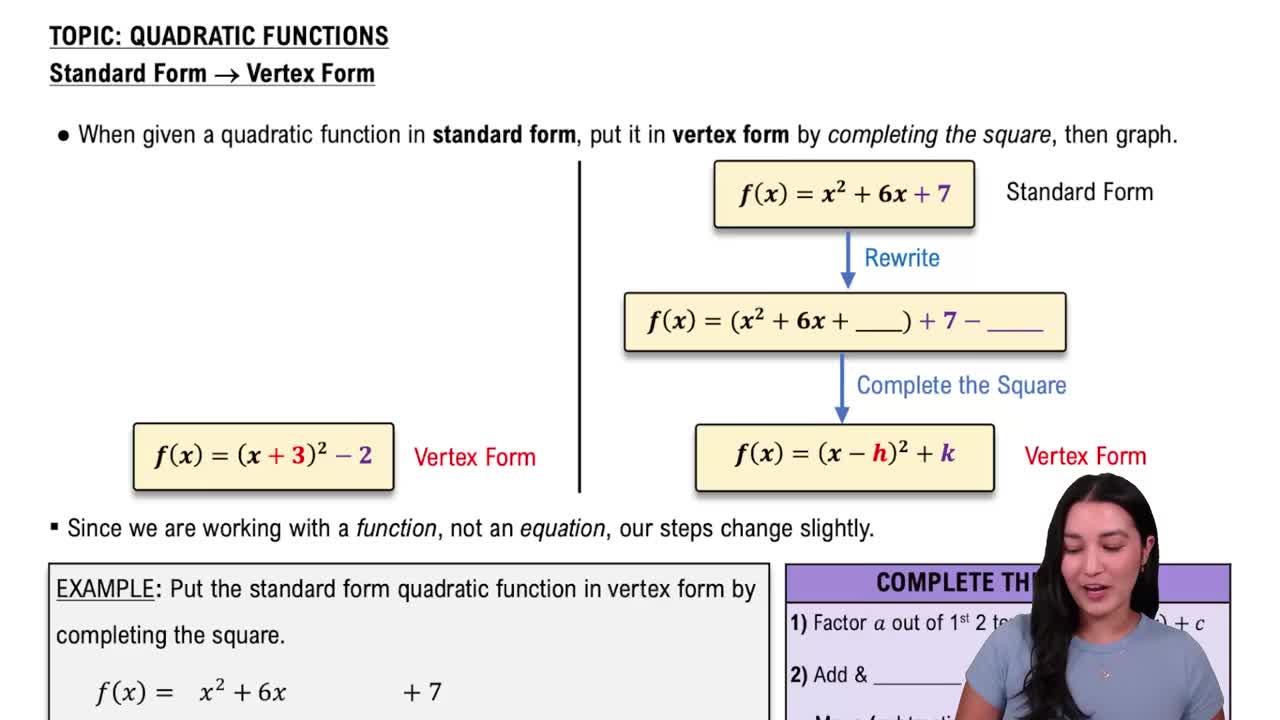
Converting Standard Form to Vertex Form

Discriminant of a Quadratic Equation

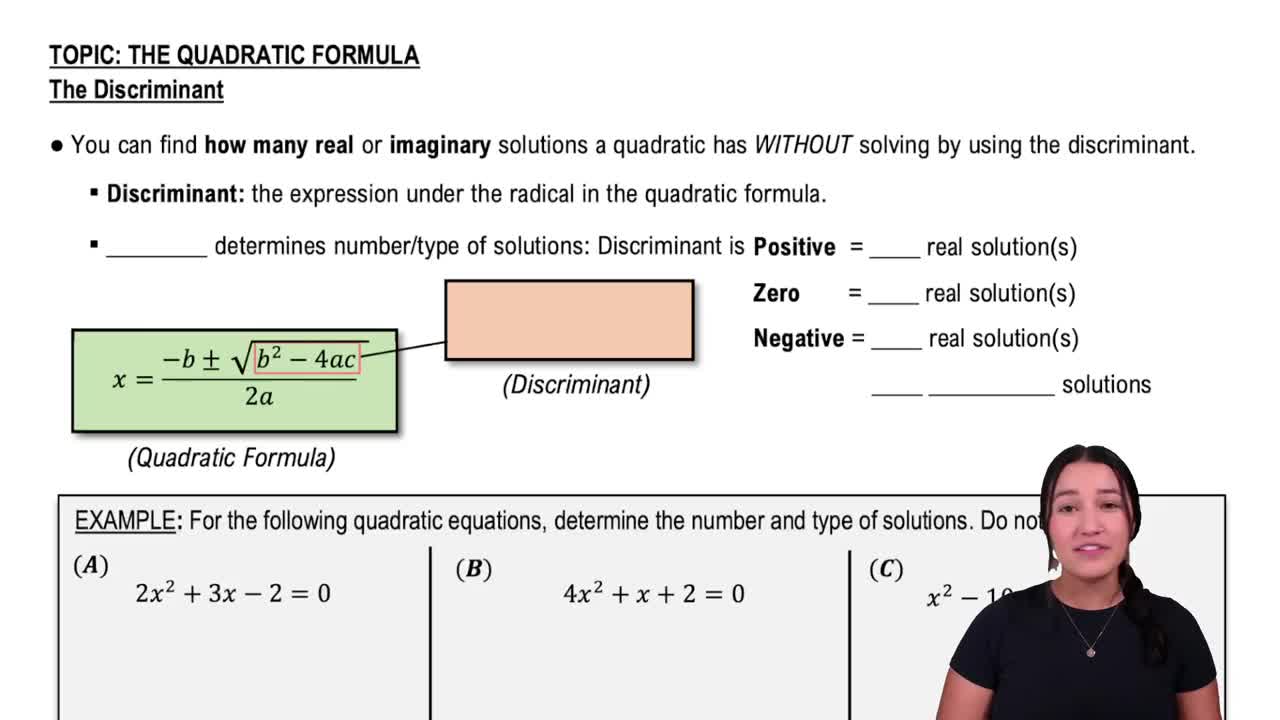
The discriminant, given by Δ = b² - 4ac, determines the nature of the roots of a quadratic equation. If Δ > 0, there are two distinct real solutions; if Δ = 0, there is one real repeated solution; and if Δ < 0, there are two complex conjugate solutions.
Video consigliato:
04:11
The Discriminant

Types of Solutions for Quadratic Equations

Quadratic equations can have real or complex solutions. Real solutions occur when the graph of the quadratic intersects the x-axis, while complex solutions occur when it does not. Understanding this helps in interpreting the discriminant without solving the equation.
Video consigliato:
05:35
Introduction to Quadratic Equations