Ch. 2 - Functions and Graphs
Blitzer - College Algebra 8th Edition
Blitzer8th EditionCollege AlgebraISBN: 9780136970514Non è quello che usi tu?Cambia libro di testo
Capitolo 3, Problema 57

Begin by graphing the standard quadratic function, f(x) = x². Then use transformations of this graph to graph the given function. h(x) = -(x − 2)²

Guida verificata passo dopo passo
1
Start by recalling the graph of the standard quadratic function \(f(x) = x^{2}\). This is a parabola opening upwards with its vertex at the origin \((0,0)\).
Identify the transformation inside the function \(h(x) = -(x - 2)^{2}\). The expression \((x - 2)\) indicates a horizontal shift of the graph of \(f(x)\) to the right by 2 units.
Next, observe the negative sign in front of the squared term. This reflects the parabola across the x-axis, changing it from opening upwards to opening downwards.
Combine these transformations: start with the graph of \(f(x) = x^{2}\), shift it right by 2 units to get \(g(x) = (x - 2)^{2}\), then reflect it over the x-axis to get \(h(x) = -(x - 2)^{2}\).
Finally, plot the vertex of \(h(x)\) at \((2, 0)\) and sketch the parabola opening downward, maintaining the same shape as the original \(f(x)\) but transformed as described.

Risposta video verificata per un problema simile:

Questa soluzione video è stata consigliata dai nostri tutor come utile per risolvere questo problema.
Durata del video:
1m

Concetti chiave

Ecco i concetti essenziali che devi comprendere per rispondere correttamente alla domanda.

Standard Quadratic Function

The standard quadratic function is f(x) = x², which graphs as a parabola opening upwards with its vertex at the origin (0,0). It serves as the base graph for understanding transformations applied to quadratic functions.
Video consigliato:
04:34
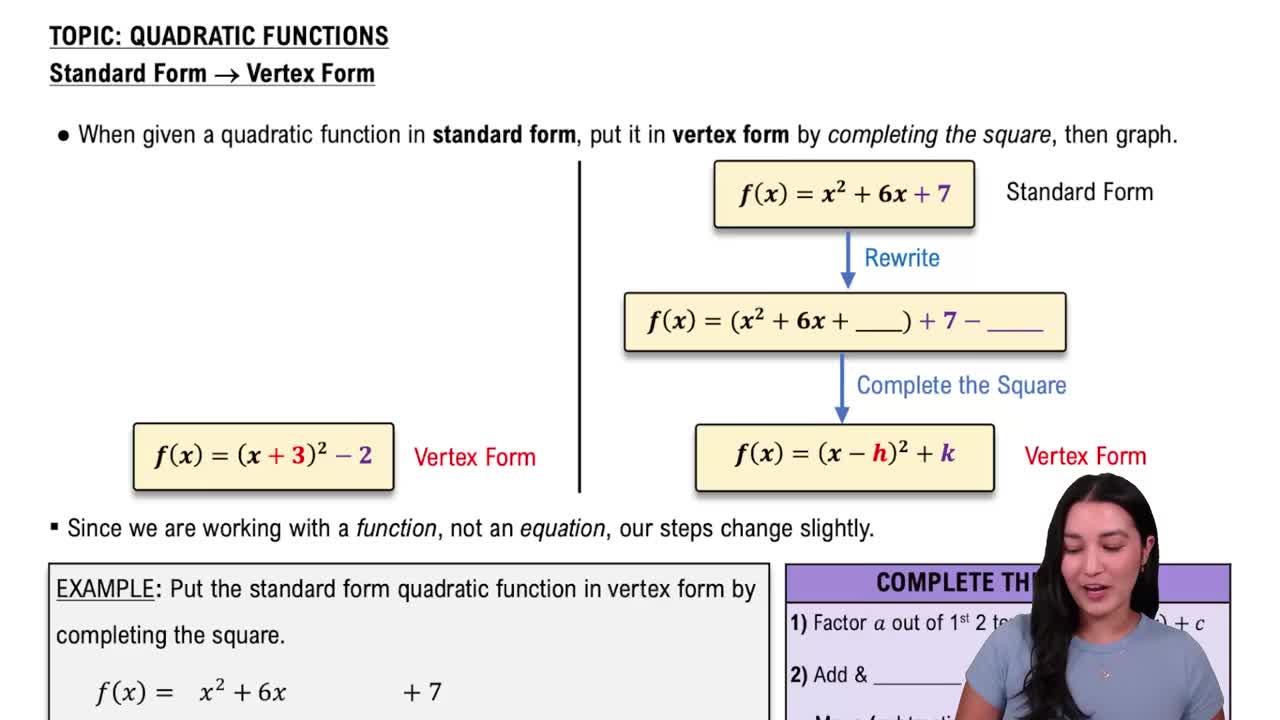
Converting Standard Form to Vertex Form

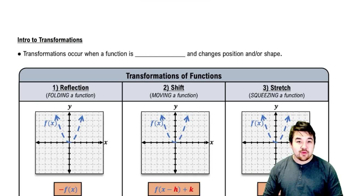
Graph Transformations

Graph transformations involve shifting, reflecting, stretching, or compressing the base graph. For h(x) = -(x − 2)², the graph is shifted right by 2 units and reflected over the x-axis due to the negative sign.
Video consigliato:
5:25
Intro to Transformations

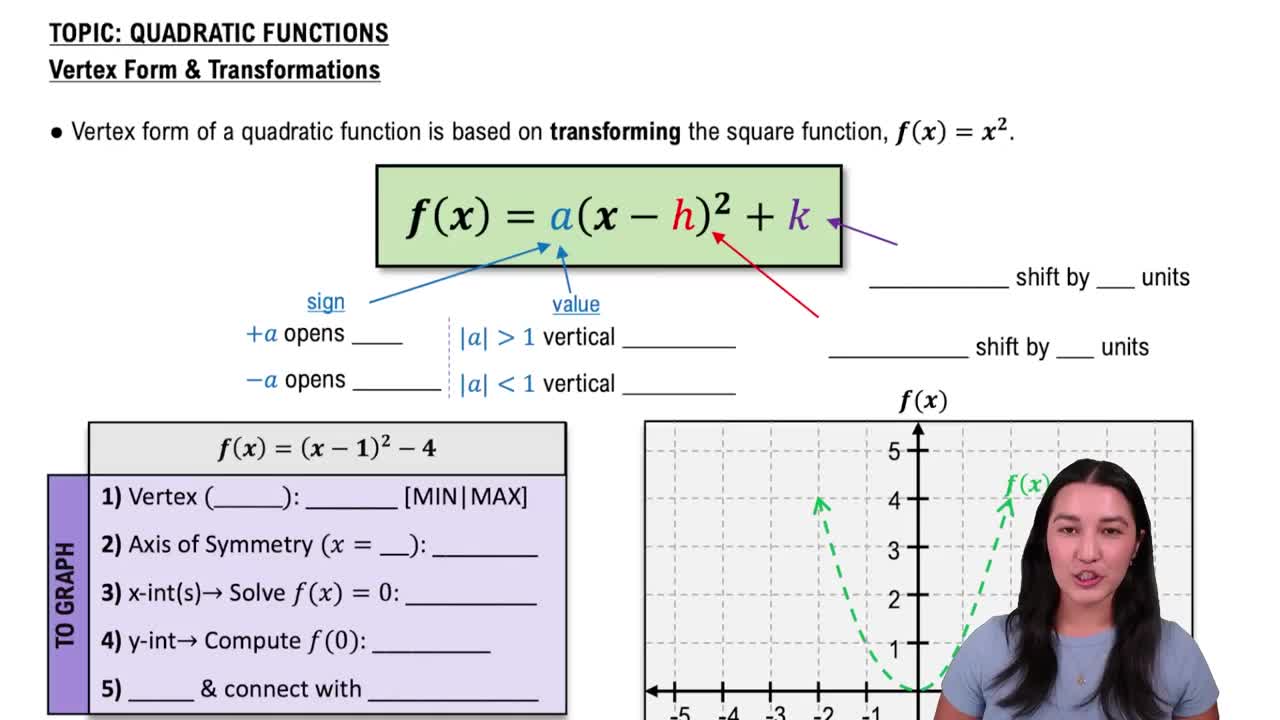
Vertex Form of a Quadratic Function

The vertex form is f(x) = a(x - h)² + k, where (h, k) is the vertex. It helps identify shifts and reflections easily. In h(x) = -(x − 2)², the vertex is at (2, 0), indicating a horizontal shift and reflection.
Video consigliato:
08:07
Vertex Form