Express the given function h as a composition of two functions ƒ and g so that h(x) = (fog) (x). h(x) = ∛(x² – 9)
Ch. 2 - Functions and Graphs

Capitolo 3, Problema 77
Find the domain of each function. g(x) = 4/(x - 7)
Guida verificata passo dopo passo1
Identify the function given: \(g(x) = \frac{4}{x - 7}\).
Recall that the domain of a function includes all real numbers except those that make the denominator zero, because division by zero is undefined.
Set the denominator equal to zero to find values to exclude: \(x - 7 = 0\).
Solve the equation for \(x\): \(x = 7\).
Conclude that the domain of \(g(x)\) is all real numbers except \(x = 7\), which can be written in interval notation as \((-\infty, 7) \cup (7, \infty)\).

Risposta video verificata per un problema simile:
Questa soluzione video è stata consigliata dai nostri tutor come utile per risolvere questo problema.
Durata del video:
1mConcetti chiave
Ecco i concetti essenziali che devi comprendere per rispondere correttamente alla domanda.
Domain of a Function
The domain of a function is the set of all possible input values (x-values) for which the function is defined. It excludes any values that cause undefined expressions, such as division by zero or taking the square root of a negative number in the real number system.
Video consigliato:
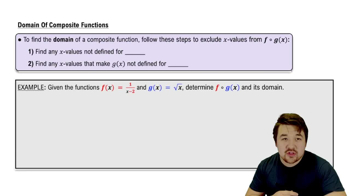
Domain Restrictions of Composed Functions
Restrictions from Denominators
When a function includes a fraction, the denominator cannot be zero because division by zero is undefined. To find the domain, identify values of x that make the denominator zero and exclude them from the domain.
Video consigliato:
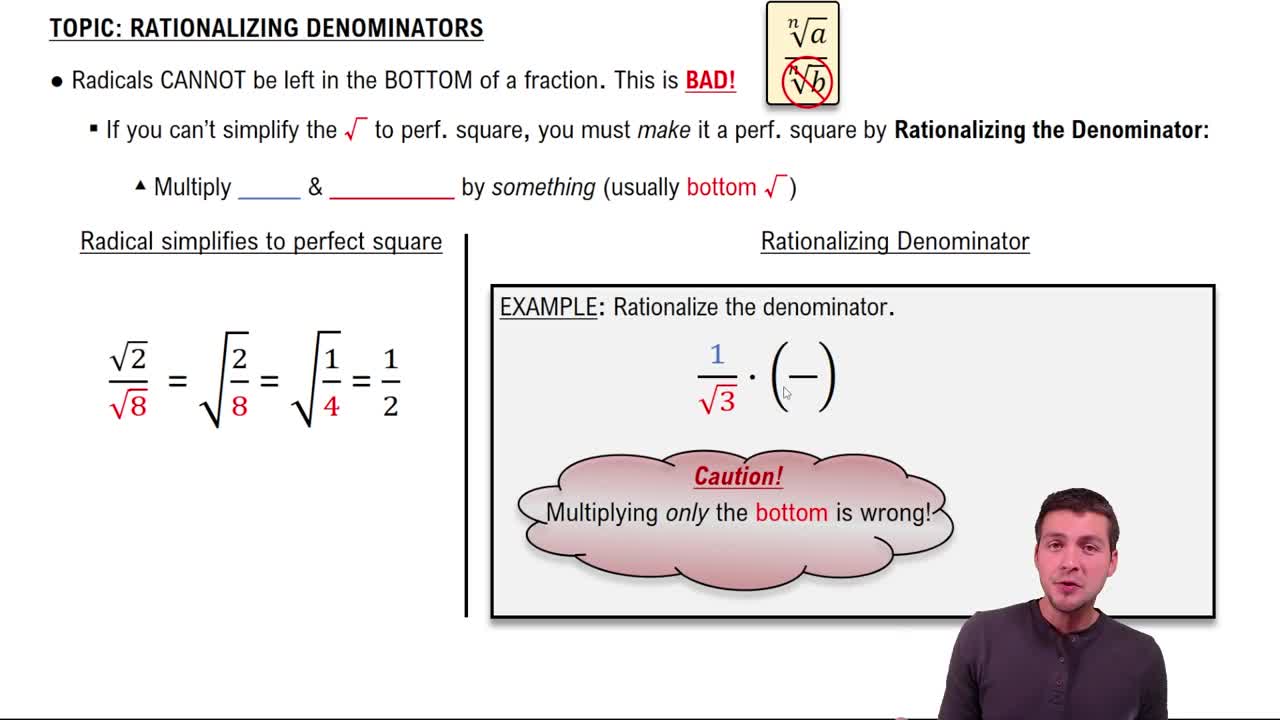
Rationalizing Denominators
Solving Equations to Find Domain Restrictions
To determine domain restrictions, set the denominator equal to zero and solve for x. The solutions are the values that must be excluded from the domain. For g(x) = 4/(x - 7), solve x - 7 = 0 to find the restricted value.
Video consigliato:
Domain Restrictions of Composed Functions
Pratica correlata
Domanda del libro di testo
1204
views
Domanda del libro di testo
Use the graph to determine a.the x-intercepts, if any; b. the y-intercept, if any; and e. the missing function values, indicated by question marks, below each graph.
962
views
Domanda del libro di testo
Begin by graphing the square root function, f(x) = √x. Then use transformations of this graph to graph the given function. g(x) = 2√(x+1)
888
views
Domanda del libro di testo
Express the given function h as a composition of two functions ƒ and g so that h(x) = (fog) (x).
h(x) = (3x − 1)4
1119
views
Domanda del libro di testo
Use the graph of g to solve Exercises 71–76.
For what value of x is g(x) = -1?
80
views
Domanda del libro di testo
In Exercises 77–92, use the graph to determine a.the x-intercepts, if any; b. the y-intercept, if any; and e. the missing function values, indicated by question marks, below each graph.
826
views