Ch. 2 - Functions and Graphs
Blitzer - College Algebra 8th Edition
Blitzer8th EditionCollege AlgebraISBN: 9780136970514Non è quello che usi tu?Cambia libro di testo
Capitolo 3, Problema 71

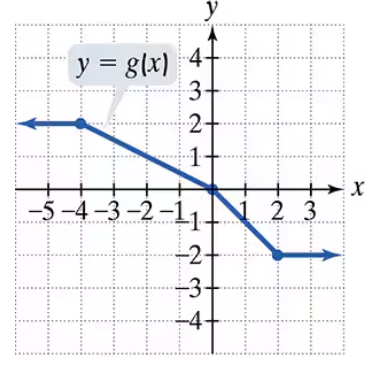
Use the graph of g to solve Exercises 71–76.

Find g(-4)

Guida verificata passo dopo passo
1
Identify the function g on the graph, which is represented by the blue line.
Locate the x-value of -4 on the horizontal axis (x-axis).
From x = -4, move vertically until you reach the point on the graph of g.
Determine the y-coordinate of this point, which represents g(-4).
Write the value of g(-4) as the y-coordinate found in the previous step.

Risposta video verificata per un problema simile:

Questa soluzione video è stata consigliata dai nostri tutor come utile per risolvere questo problema.
Durata del video:
2m

Concetti chiave

Ecco i concetti essenziali che devi comprendere per rispondere correttamente alla domanda.

Function and Function Notation

A function relates each input (x) to exactly one output (y). Function notation, such as g(-4), means finding the output value of g when the input is -4. Understanding this helps interpret what the question asks: the y-value corresponding to x = -4 on the graph.
Video consigliato:
4:56
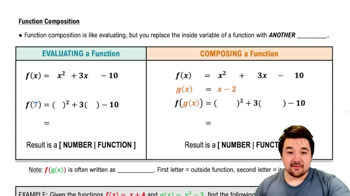
Function Composition

Reading Values from a Graph

To find g(-4) using the graph, locate the point where x = -4 on the horizontal axis, then find the corresponding y-value on the curve. This y-value is the output of the function at that input. Accurate reading of coordinates from the graph is essential.
Video consigliato:
05:10
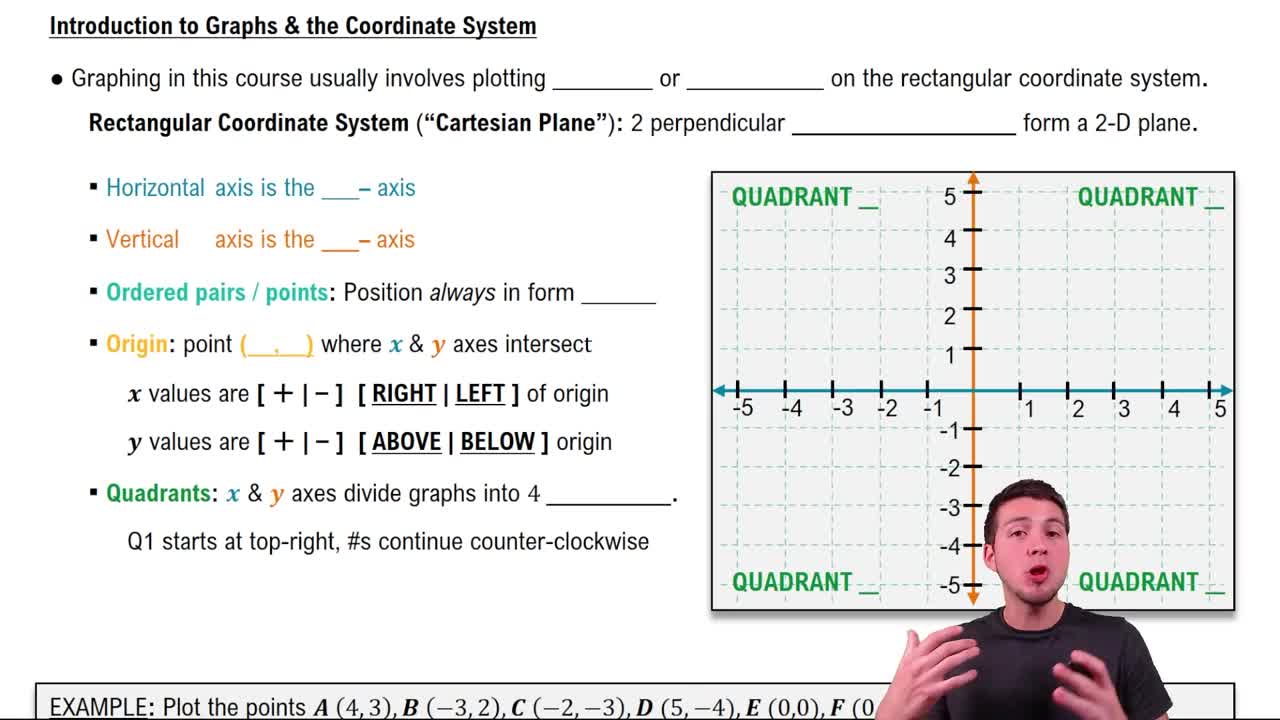
Graphs & the Rectangular Coordinate System

Coordinate Plane and Axes

The coordinate plane consists of the x-axis (horizontal) and y-axis (vertical), which intersect at the origin (0,0). Points on the graph are given as (x, y). Understanding the axes and how to plot or read points is fundamental to interpreting the graph and solving for function values.
Video consigliato:
05:10
Graphs & the Rectangular Coordinate System