Indietro
Problema 56
Begin by graphing f(x) = log₂ x. Then use transformations of this graph to graph the given function. What is the vertical asymptote? Use the graphs to determine each function's domain and range. h(x) = 2 + log2x
Problema 57
In Exercises 53-58, begin by graphing f(x) = log₂ x. Then use transformations of this graph to graph the given function. What is the vertical asymptote? Use the graphs to determine each function's domain and range. g(x) = (1/2)log₂ x
Problema 59
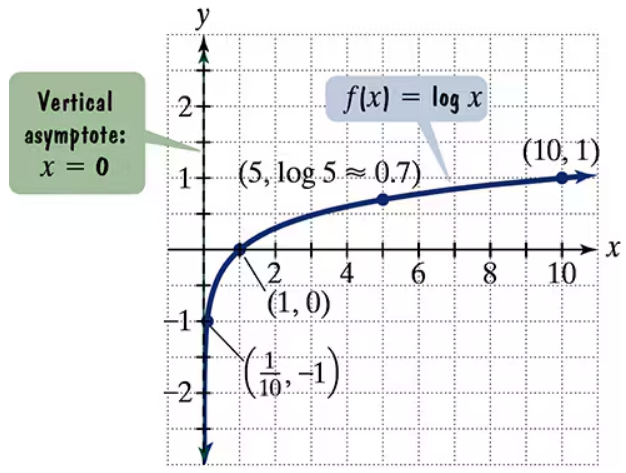
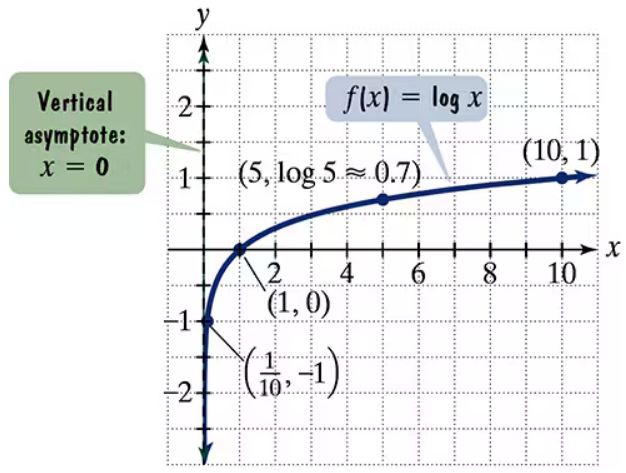
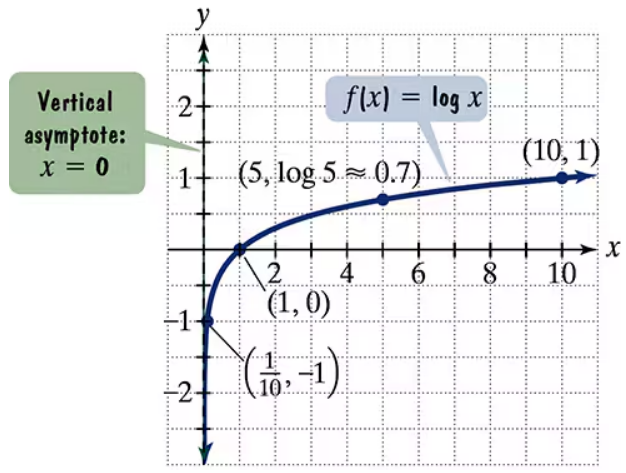
The figure shows the graph of f(x) = log x. In Exercises 59–64, use transformations of this graph to graph each function. Graph and give equations of the asymptotes. Use the graphs to determine each function's domain and range. g(x) = log(x − 1)
Problema 61
The figure shows the graph of f(x) = log x. In Exercises 59–64, use transformations of this graph to graph each function. Graph and give equations of the asymptotes. Use the graphs to determine each function's domain and range. h(x) = log x − 1
Problema 63
The figure shows the graph of f(x) = log x. In Exercises 59–64, use transformations of this graph to graph each function. Graph and give equations of the asymptotes. Use the graphs to determine each function's domain and range.
g(x) = 1-log x
Problema 65
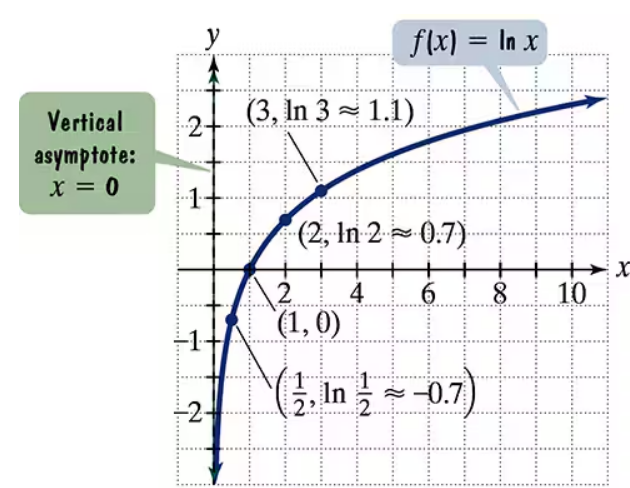
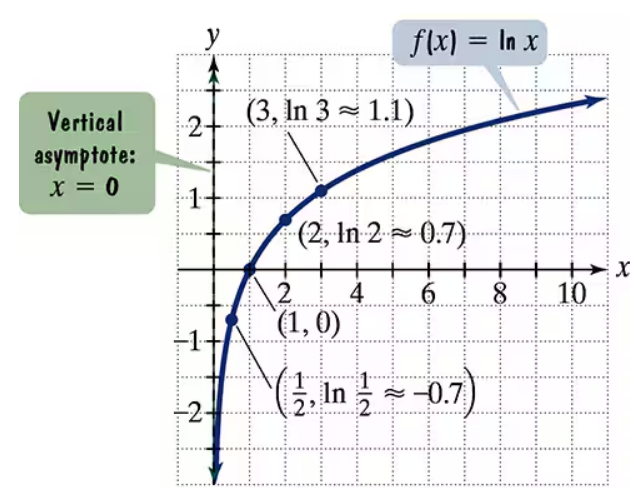
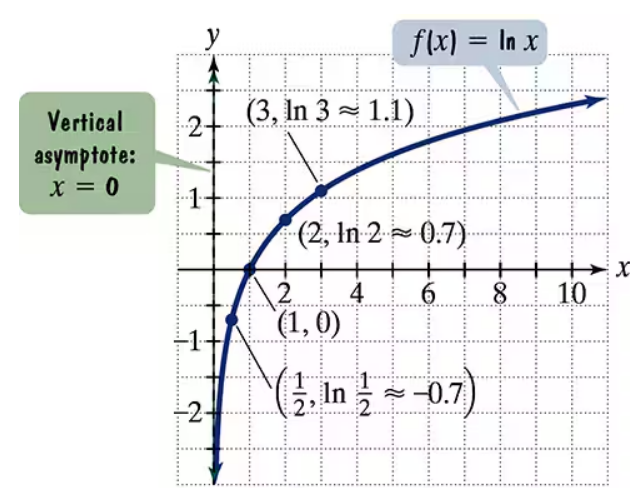
The figure shows the graph of f(x) = ln x. In Exercises 65–74, use transformations of this graph to graph each function. Graph and give equations of the asymptotes. Use the graphs to determine each function's domain and range. g(x) = ln (x+2)
Problema 67
The figure shows the graph of f(x) = ln x. In Exercises 65–74, use transformations of this graph to graph each function. Graph and give equations of the asymptotes. Use the graphs to determine each function's domain and range.
h(x) = ln (2x)
Problema 68
The figure shows the graph of f(x) = ln x. In Exercises 65–74, use transformations of this graph to graph each function. Graph and give equations of the asymptotes. Use the graphs to determine each function's domain and range. h(x) = ln(x/2)
Problema 69
The figure shows the graph of f(x) = ln x. In Exercises 65–74, use transformations of this graph to graph each function. Graph and give equations of the asymptotes. Use the graphs to determine each function's domain and range. g(x) = 2 ln x
Problema 75
Find the domain of each logarithmic function. f(x) = log5(x+4)
Problema 77
Find the domain of each logarithmic function. f(x) = log (2 - x)
Problema 79
Find the domain of each logarithmic function. f(x) = ln (x-2)²
Problema 81
Evaluate or simplify each expression without using a calculator. log 100
Problema 83
Evaluate or simplify each expression without using a calculator. log 107
Problema 85
Evaluate or simplify each expression without using a calculator. 10log 33
Problema 87
Evaluate or simplify each expression without using a calculator. In 1
Problema 88
Evaluate or simplify each expression without using a calculator. In e
Problema 89
Evaluate or simplify each expression without using a calculator. In e6
Problema 91
Evaluate or simplify each expression without using a calculator. In (1/e6)
Problema 93
Evaluate or simplify each expression without using a calculator. eln 125
Problema 95
Evaluate or simplify each expression without using a calculator. In e9x
Problema 97
Evaluate or simplify each expression without using a calculator.
Problema 99
Evaluate or simplify each expression without using a calculator. 10log √x
Problema 100
Evaluate or simplify each expression without using a calculator. 10log ∛x
Problema 101
Write each equation in its equivalent exponential form. Then solve for x. log3 (x-1) = 2
Problema 1
Use properties of logarithms to expand each logarithmic expression as much as possible. Where possible, evaluate logarithmic expressions without using a calculator. log5 (7 × 3)
Problema 3
Use properties of logarithms to expand each logarithmic expression as much as possible. Where possible, evaluate logarithmic expressions without using a calculator. log7 (7x)
Problema 5
Use properties of logarithms to expand each logarithmic expression as much as possible. Where possible, evaluate logarithmic expressions without using a calculator. log(1000x)
Problema 7
Use properties of logarithms to expand each logarithmic expression as much as possible. Where possible, evaluate logarithmic expressions without using a calculator. log7 (7/x)
Problema 9
Use properties of logarithms to expand each logarithmic expression as much as possible. Where possible, evaluate logarithmic expressions without using a calculator. log(x/100)