Ch. 5 - Systems of Equations and Inequalities
Blitzer - College Algebra 8th Edition
Blitzer8th EditionCollege AlgebraISBN: 9780136970514Non è quello che usi tu?Cambia libro di testo
Capitolo 6, Problema 11

An objective function and a system of linear inequalities representing constraints are given. a. Graph the system of inequalities representing the constraints. b. Find the value of the objective function at each corner of the graphed region. c. Use the values in part (b) to determine the maximum value of the objective function and the values of x and y for which the maximum occurs.
Objective function z = 4x + 2y with constraints x≥0, y≥0, 2x+3y≤12, 3x+2y≤12, x+y≥2.

Guida verificata passo dopo passo
1
Step 1: Identify the objective function and the system of inequalities. The objective function is \(z = 2x + 6y\), and the constraints are: \[ \begin{cases} x \geq 0, \ y \geq 0, \\ -3x + 4y \leq 20, \\ 4x + y \leq 24, \\ x + 2y \geq 4 \end{cases} \]
Step 2: Graph the inequalities one by one on the coordinate plane. Start by graphing the boundary lines (replace inequalities with equalities): - \(x = 0\) (the y-axis), - \(y = 0\) (the x-axis), - \(-3x + 4y = 20\), - \(4x + y = 24\), - \(x + 2y = 4\). For each line, determine which side satisfies the inequality by testing a point not on the line (usually the origin if it is not on the line).
Step 3: Determine the feasible region by finding the intersection of all the half-planes defined by the inequalities. This region will be bounded by the lines and will satisfy all constraints simultaneously.
Step 4: Find the corner points (vertices) of the feasible region by solving the systems of equations formed by the intersection of the boundary lines. For example, solve pairs like: - \(x=0\) and \(-3x + 4y = 20\), - \(-3x + 4y = 20\) and \(4x + y = 24\), - \(4x + y = 24\) and \(x + 2y = 4\), - \(x + 2y = 4\) and \(x=0\), and any other relevant intersections that form the polygon of the feasible region.
Step 5: Evaluate the objective function \(z = 2x + 6y\) at each corner point found in Step 4. Compare these values to determine which corner point gives the maximum value of \(z\). The maximum value and the corresponding \((x, y)\) coordinates are the solution to the problem.

Risposta video verificata per un problema simile:

Questa soluzione video è stata consigliata dai nostri tutor come utile per risolvere questo problema.
Durata del video:
19m

Concetti chiave

Ecco i concetti essenziali che devi comprendere per rispondere correttamente alla domanda.

Graphing Systems of Linear Inequalities

Graphing systems of linear inequalities involves plotting each inequality on the coordinate plane and shading the region that satisfies the inequality. The solution to the system is the intersection of all shaded regions, called the feasible region. Understanding how to graph and interpret these regions is essential for visualizing constraints.
Video consigliato:
6:19
Systems of Inequalities

Corner Points (Vertices) of the Feasible Region

The feasible region formed by the system of inequalities is a polygon, and its corner points or vertices are where the boundary lines intersect. These points are critical because, in linear programming, the maximum or minimum values of the objective function occur at these vertices.
Video consigliato:
05:10
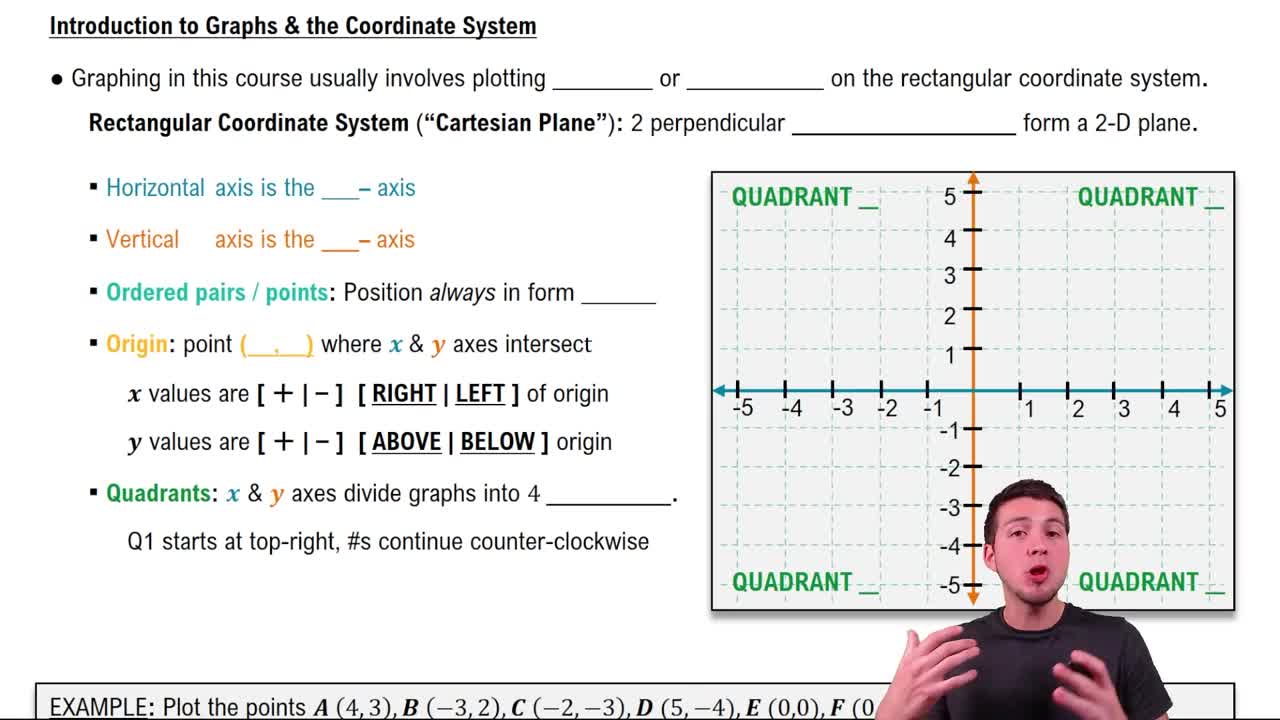
Graphs & the Rectangular Coordinate System

Evaluating the Objective Function at Vertices

The objective function, such as z = 2x + 6y, is evaluated at each vertex of the feasible region to find the maximum or minimum value. By substituting the coordinates of each corner point into the function, one can determine which point yields the optimal value under the given constraints.
Video consigliato:
4:26
Evaluating Composed Functions