Ch. 5 - Systems of Equations and Inequalities
Blitzer - College Algebra 8th Edition
Blitzer8th EditionCollege AlgebraISBN: 9780136970514Non è quello che usi tu?Cambia libro di testo
Capitolo 6, Problema 12

Graph each inequality. y>−3

Guida verificata passo dopo passo
1
Identify the inequality given: \(y > -3\). This means we are looking for all points where the y-coordinate is greater than -3.
Graph the boundary line \(y = -3\). Since the inequality is strict (greater than, not greater than or equal to), draw this line as a dashed horizontal line to indicate that points on the line are not included.
Determine which side of the line to shade. Since the inequality is \(y > -3\), shade the region above the line \(y = -3\) because those points have y-values greater than -3.
Check a test point not on the boundary line to confirm the shading. For example, use the point \((0,0)\): since \(0 > -3\) is true, the region containing \((0,0)\) should be shaded.
Label the graph clearly with the dashed line at \(y = -3\) and the shaded region above it to represent all solutions to the inequality \(y > -3\).

Risposta video verificata per un problema simile:

Questa soluzione video è stata consigliata dai nostri tutor come utile per risolvere questo problema.
Durata del video:
3m

Concetti chiave

Ecco i concetti essenziali che devi comprendere per rispondere correttamente alla domanda.

Graphing Linear Inequalities

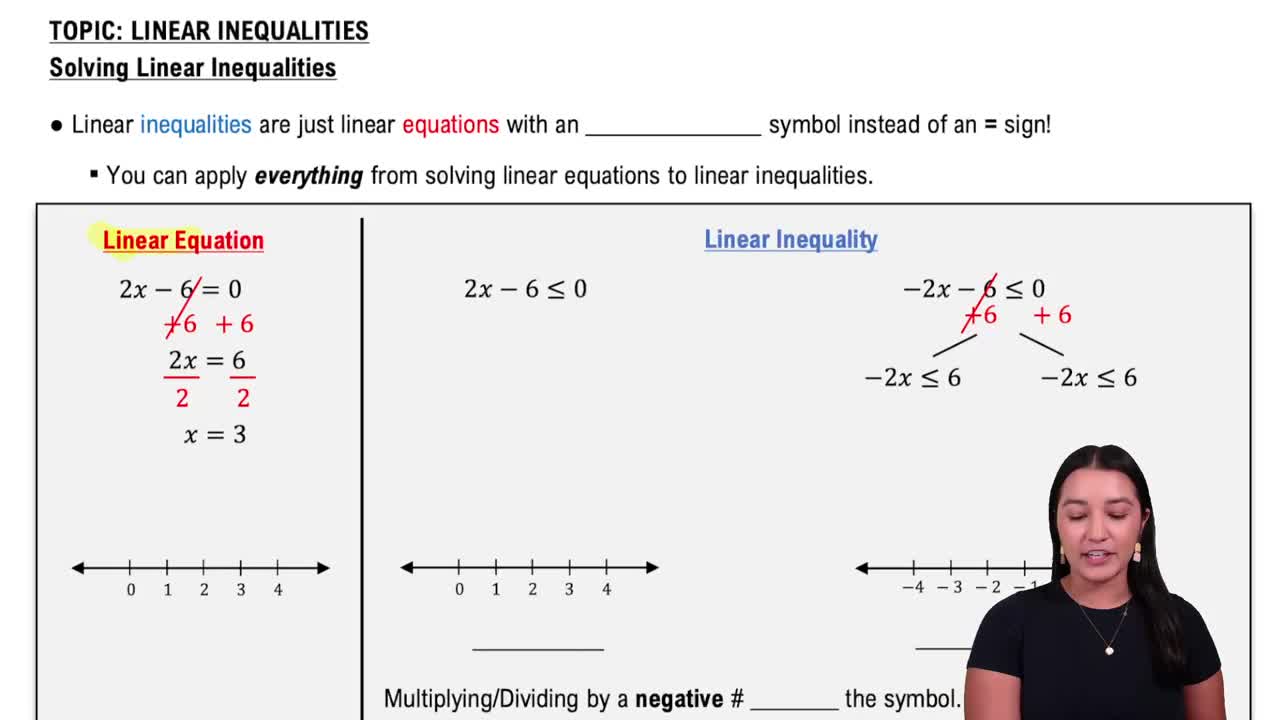
Graphing linear inequalities involves shading a region of the coordinate plane that satisfies the inequality. For an inequality like y > -3, you first graph the boundary line y = -3, then determine which side of the line to shade based on the inequality symbol.
Video consigliato:
06:07
Linear Inequalities

Boundary Lines and Their Types

The boundary line for an inequality is drawn as either solid or dashed. A solid line is used for ≤ or ≥ inequalities, indicating points on the line are included. A dashed line is used for < or > inequalities, indicating points on the line are not included in the solution.
Video consigliato:
05:17
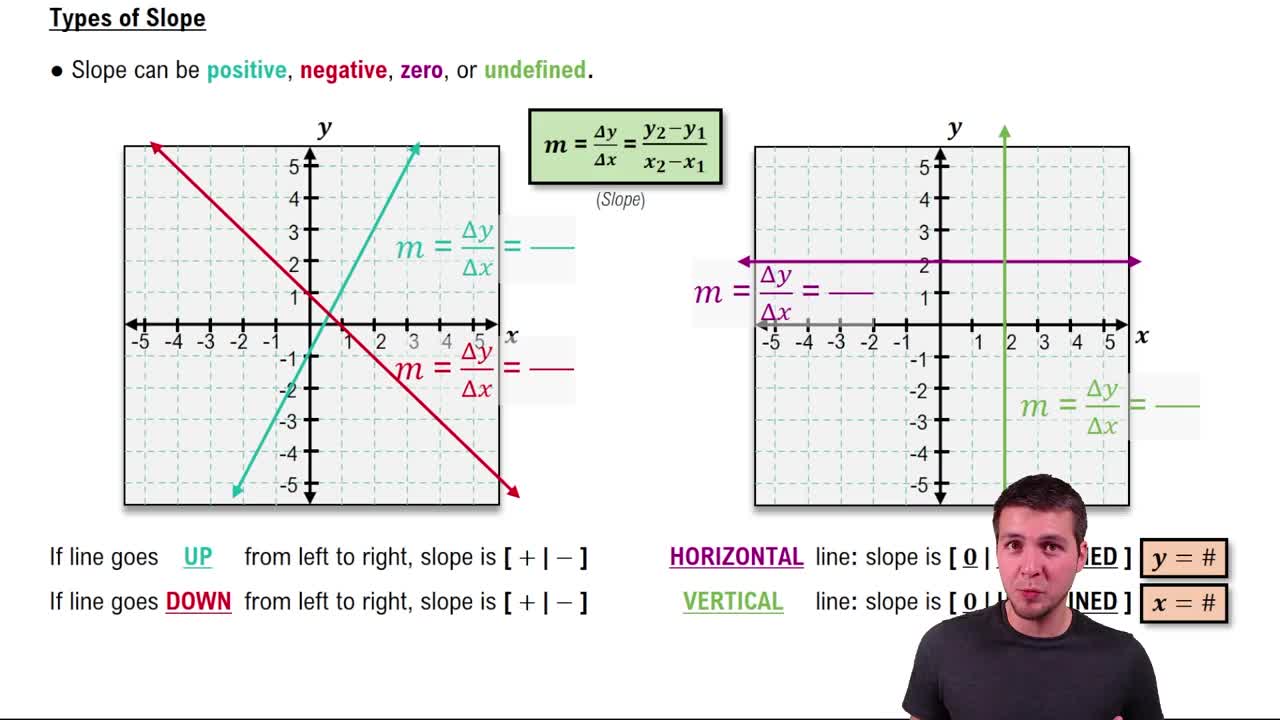
Types of Slope

Testing Points to Determine Shading

To decide which side of the boundary line to shade, select a test point not on the line (often (0,0)) and substitute it into the inequality. If the inequality holds true, shade the side containing the test point; otherwise, shade the opposite side.
Video consigliato:
4:36
Determinants of 2×2 Matrices