

Ch.13 - Properties of Solutions
Brown - Chemistry: The Central Science 14th Edition
Brown14th EditionChemistry: The Central ScienceISBN: 9780134414232Non è quello che usi tu?Cambia libro di testo
Capitolo 13, Problema 59

During a person’s typical breathing cycle, the CO2 concentration in the expired air rises to a peak of 4.6% by volume. (b) What is the molarity of the CO2 in the expired air at its peak, assuming a body temperature of 37 °C?

Guida verificata passo dopo passo
1
Convert the percentage by volume of CO2 to a fraction by dividing by 100. This gives the volume fraction of CO2 in the expired air.
Use the ideal gas law, PV = nRT, to relate the volume fraction to molarity. Assume the pressure is 1 atm and convert the temperature from Celsius to Kelvin by adding 273.15 to 37 °C.
Calculate the volume of 1 mole of gas at 37 °C and 1 atm using the ideal gas law. This will give you the volume in liters that 1 mole of gas occupies under these conditions.
Determine the number of moles of CO2 in the expired air by multiplying the volume fraction of CO2 by the volume of 1 mole of gas calculated in the previous step.
Calculate the molarity of CO2 by dividing the number of moles of CO2 by the volume of the gas in liters. This will give you the molarity of CO2 in the expired air.

Concetti chiave

Ecco i concetti essenziali che devi comprendere per rispondere correttamente alla domanda.

Molarity

Molarity is a measure of concentration defined as the number of moles of solute per liter of solution. It is expressed in moles per liter (mol/L) and is crucial for understanding how much of a substance is present in a given volume of solution. In this context, we need to calculate the molarity of CO2 in the expired air, which involves converting the percentage by volume into moles and then relating it to the volume of air.
Video consigliato:

Ideal Gas Law

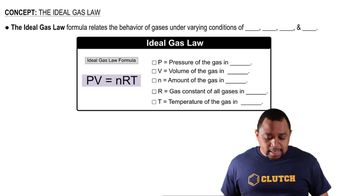
The Ideal Gas Law is a fundamental equation in chemistry that relates the pressure, volume, temperature, and number of moles of a gas. It is expressed as PV = nRT, where P is pressure, V is volume, n is the number of moles, R is the ideal gas constant, and T is temperature in Kelvin. This law allows us to calculate the number of moles of CO2 in the expired air based on its volume and temperature.
Video consigliato:
Percorso guidato
01:15
Ideal Gas Law Formula

Body Temperature and Gas Behavior

Body temperature, typically around 37 °C, affects the behavior of gases, including their volume and pressure. When calculating gas concentrations, it is essential to convert the temperature to Kelvin (310 K) and consider how temperature influences gas properties. This understanding is necessary for accurately applying the Ideal Gas Law to determine the molarity of CO2 in the expired air.
Video consigliato:
Percorso guidato
00:40
Body Centered Cubic Example