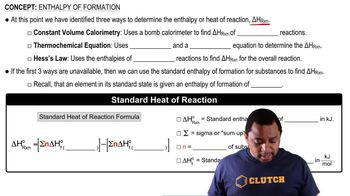
From the following data for three prospective fuels, calculate which could provide the most energy per unit mass and per unit volume:
Ch.5 - Thermochemistry
Brown14th EditionChemistry: The Central ScienceISBN: 9780134414232Non è quello che usi tu?Cambia libro di testo
Capitolo 5, Problema 112
The hydrocarbons cyclohexane (C6H12), ΔHf° = -156 kJ/mol, and 1-hexene (C6H12), ΔHf° = -74 kJ/mol, have the same empirical formula. (a) Calculate the standard enthalpy change for the transformation of cyclohexane to 1-hexene. (b) Which has greater enthalpy, cyclohexane or 1-hexene?
Guida verificata passo dopo passo1
Step 1: Understand the problem by identifying the given data: Cyclohexane (C6H12) has a standard enthalpy of formation (ΔHf°) of -156 kJ/mol, and 1-hexene (C6H12) has a ΔHf° of -74 kJ/mol.
Step 2: To find the standard enthalpy change (ΔH°) for the transformation of cyclohexane to 1-hexene, use the formula: ΔH° = ΔHf°(products) - ΔHf°(reactants).
Step 3: Substitute the given values into the formula: ΔH° = (-74 kJ/mol) - (-156 kJ/mol).
Step 4: Simplify the expression by subtracting the enthalpy of formation of cyclohexane from that of 1-hexene.
Step 5: To determine which compound has greater enthalpy, compare the ΔHf° values: the compound with the less negative (or more positive) ΔHf° has greater enthalpy.
Concetti chiave
Ecco i concetti essenziali che devi comprendere per rispondere correttamente alla domanda.
Standard Enthalpy of Formation (ΔHf°)
The standard enthalpy of formation (ΔHf°) is the change in enthalpy when one mole of a compound is formed from its elements in their standard states. It provides a reference point for calculating the enthalpy changes in chemical reactions. In this question, the ΔHf° values for cyclohexane and 1-hexene are essential for determining the enthalpy change during the transformation between these two hydrocarbons.
Video consigliato:
Percorso guidato
Enthalpy of Formation
Enthalpy Change (ΔH)
Enthalpy change (ΔH) is the heat content change associated with a chemical reaction at constant pressure. It can be calculated using the formula ΔH = ΣΔHf°(products) - ΣΔHf°(reactants). In this case, the enthalpy change for the transformation from cyclohexane to 1-hexene can be determined by subtracting the ΔHf° of cyclohexane from that of 1-hexene.
Video consigliato:
Percorso guidato
Enthalpy of Formation
Comparison of Enthalpy Values
Comparing the enthalpy values of different compounds helps determine their stability and energy content. A compound with a lower ΔHf° is generally more stable and has lower energy than one with a higher ΔHf°. In this question, analyzing the ΔHf° values of cyclohexane and 1-hexene allows us to conclude which compound has greater enthalpy and thus is less stable.
Video consigliato:
Percorso guidato
Enthalpy of Formation
Pratica correlata
Domanda del libro di testo
569
views
Domanda del libro di testo
When magnesium metal is burned in air (Figure 3.6), two
products are produced. One is magnesium oxide, MgO. The
other is the product of the reaction of Mg with molecular
nitrogen, magnesium nitride. When water is added to magnesium
nitride, it reacts to form magnesium oxide and ammonia
gas. (e) The
standard enthalpy of formation of solid magnesium nitride is
-461.08 kJ>mol. Calculate the standard enthalpy change for
the reaction between magnesium metal and ammonia gas.
2062
views
Domanda del libro di testo
A 201-lb man decides to add to his exercise routine by walking up three flights of stairs (45 ft) 20 times per day. Hefigures that theworkrequired to increasehis potential energy in this way will permit him to eat an extra order of French fries, at 245 Cal, without adding to his weight. Is he correct in this assumption?
357
views
Domanda del libro di testo
We can use Hess's law to calculate enthalpy changes that cannot be measured. One such reaction is the conversion of methane to ethane: 2 CH4(g) → C2H6(g) + H2(g) Calculate the ΔH° for this reaction using the following thermochemical data: CH4(g) + 2 O2(g) → CO2(g) + 2 H2O(l) ΔH° = -890.3 kJ 2 H2(g) + O2(g) → 2 H2O(l) H° = -571.6 kJ 2 C2H6(g) + 7 O2(g) → 4 CO2(g) + 6 H2O(l) ΔH° = -3120.8 kJ
1171
views