Ch.8 - Basic Concepts of Chemical Bonding
Brown - Chemistry: The Central Science 14th Edition
Brown14th EditionChemistry: The Central ScienceISBN: 9780134414232Non è quello che usi tu?Cambia libro di testo
Capitolo 8, Problema 86b

The substance chlorine monoxide, ClO(g), is important in atmospheric processes that lead to depletion of the ozone layer. The ClO molecule has an experimental dipole moment of 1.24 D, and the Cl—O bond length is 160 pm. (b) Based on the electronegativities of the elements, which atom would you expect to have a partial negative charge in the ClO molecule?

Guida verificata passo dopo passo
1
Identify the elements in the ClO molecule: chlorine (Cl) and oxygen (O).
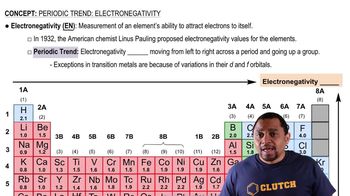
Recall that electronegativity is a measure of an atom's ability to attract and hold onto electrons.
Consult a periodic table or electronegativity chart to find the electronegativities of Cl and O. Typically, oxygen has a higher electronegativity than chlorine.
Determine which atom has the higher electronegativity. The atom with the higher electronegativity will attract the shared electrons more strongly, resulting in a partial negative charge.
Conclude that the atom with the higher electronegativity in the ClO molecule will have the partial negative charge.

Risposta video verificata per un problema simile:

Questa soluzione video è stata consigliata dai nostri tutor come utile per risolvere questo problema.
Durata del video:
1m

Concetti chiave

Ecco i concetti essenziali che devi comprendere per rispondere correttamente alla domanda.

Electronegativity

Electronegativity is a measure of an atom's ability to attract and hold onto electrons in a chemical bond. In a molecule, the atom with higher electronegativity will attract the shared electrons more strongly, leading to a partial negative charge on that atom. For chlorine monoxide (ClO), comparing the electronegativities of chlorine and oxygen helps determine which atom will have the partial negative charge.
Video consigliato:
Percorso guidato
02:10
Electronegativity Trends

Dipole Moment

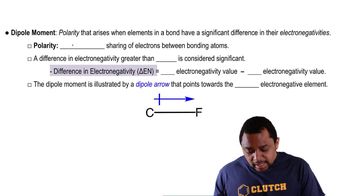
A dipole moment is a vector quantity that represents the separation of positive and negative charges in a molecule. It is influenced by the difference in electronegativity between bonded atoms and the geometry of the molecule. The presence of a dipole moment in ClO indicates that there is an uneven distribution of electron density, which is crucial for understanding the polarity of the molecule and predicting the location of partial charges.
Video consigliato:

Bond Length

Bond length is the distance between the nuclei of two bonded atoms, typically measured in picometers (pm). It is influenced by the size of the atoms and the type of bond formed. In the case of ClO, the bond length of 160 pm provides insight into the strength and characteristics of the Cl—O bond, which can also affect the molecule's polarity and the distribution of charges.
Video consigliato:
Percorso guidato
00:36
Average Bond Order