
Ch.8 - Basic Concepts of Chemical Bonding
Brown - Chemistry: The Central Science 14th Edition
Brown14th EditionChemistry: The Central ScienceISBN: 9780134414232Non è quello che usi tu?Cambia libro di testo
Capitolo 8, Problema 86c,d

The substance chlorine monoxide, ClO(g), is important in atmospheric processes that lead to depletion of the ozone layer. The ClO molecule has an experimental dipole moment of 1.24 D, and the Cl—O bond length is 160 pm. (c) Using formal charges as a guide, propose the dominant Lewis structure for the molecule. (g), is important in atmospheric processes that lead to depletion of the ozone layer. The ClO molecule has an experimental dipole moment of 1.24 D, and the Cl—O bond length is 160 pm. (d) The anion ClO exists. What is the formal charge on the Cl for the best Lewis structure for ClO-?

Guida verificata passo dopo passo
1
Step 1: To propose the dominant Lewis structure for ClO, start by determining the total number of valence electrons. Chlorine (Cl) has 7 valence electrons, and oxygen (O) has 6 valence electrons. Therefore, ClO has a total of 13 valence electrons.
Step 2: Arrange the atoms with Cl and O bonded together. Place the remaining electrons around the atoms to satisfy the octet rule, starting with the more electronegative atom, which is oxygen.
Step 3: Calculate the formal charges for each atom in the proposed Lewis structure. The formal charge is calculated using the formula: \( \text{Formal Charge} = \text{Valence Electrons} - \text{Non-bonding Electrons} - \frac{1}{2} \times \text{Bonding Electrons} \). Adjust the structure to minimize formal charges.
Step 4: For the ClO- anion, add an extra electron to the total valence electrons, making it 14. Construct the Lewis structure with Cl and O bonded, and distribute the electrons to satisfy the octet rule.
Step 5: Calculate the formal charge on Cl in ClO-. Use the formula for formal charge and ensure that the structure with the lowest formal charges is chosen. The formal charge on Cl should be calculated considering the extra electron in the anion.

Risposta video verificata per un problema simile:

Questa soluzione video è stata consigliata dai nostri tutor come utile per risolvere questo problema.
Durata del video:
3m

Concetti chiave

Ecco i concetti essenziali che devi comprendere per rispondere correttamente alla domanda.

Lewis Structures

Lewis structures are diagrams that represent the bonding between atoms in a molecule and the lone pairs of electrons that may exist. They help visualize the arrangement of electrons and the connectivity of atoms, allowing chemists to predict molecular geometry and reactivity. In the case of ClO, drawing the Lewis structure involves determining how many valence electrons are available and how they are distributed among the chlorine and oxygen atoms.
Video consigliato:
Percorso guidato
04:28
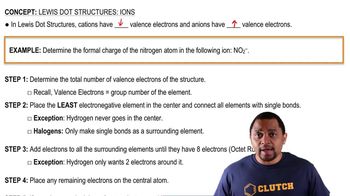
Lewis Dot Structures: Ions

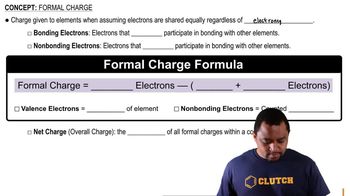
Formal Charge

Formal charge is a theoretical charge assigned to an atom in a molecule, calculated based on the number of valence electrons, the number of non-bonding electrons, and the number of bonds formed. It helps in evaluating the most stable Lewis structure by minimizing the formal charges across the molecule. For ClO and its anion ClO<sup>-</sup>, calculating the formal charge on chlorine involves considering its valence electrons and how they are shared or unshared in the structure.
Video consigliato:

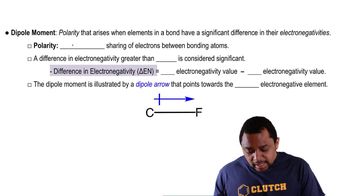
Dipole Moment

The dipole moment is a measure of the separation of positive and negative charges in a molecule, indicating its polarity. It is influenced by the electronegativity of the atoms involved and the geometry of the molecule. In ClO, the dipole moment of 1.24 D suggests that there is a significant difference in electronegativity between chlorine and oxygen, leading to a polar bond that affects the molecule's behavior in atmospheric processes.
Video consigliato: