
Ch.15 - Chemical Equilibrium
Brown - Chemistry: The Central Science 15th Edition
Brown15th EditionChemistry: The Central ScienceISBN: 9780137542970Non è quello che usi tu?Cambia libro di testo
Capitolo 15, Problema 54

Consider the reaction \( \text{CaSO}_4(\text{s}) \rightleftharpoons \text{Ca}^{2+}(\text{aq}) + \text{SO}_4^{2-}(\text{aq}) \) At 25 °C, the equilibrium constant is \( K_c = 2.4 \times 10^{-5} \) for this reaction. (a) If excess \( \text{CaSO}_4(\text{s}) \) is mixed with water at 25 °C to produce a saturated solution of \( \text{CaSO}_4 \), what are the equilibrium concentrations of \( \text{Ca}^{2+} \) and \( \text{SO}_4^{2-} \)? (b) If the resulting solution has a volume of 1.4 L, what is the minimum mass of \( \text{CaSO}_4(\text{s}) \) needed to achieve equilibrium?

Guida verificata passo dopo passo
1
Step 1: Understand the reaction and equilibrium expression. The dissolution of calcium sulfate in water is represented by the equation: \( \text{CaSO}_4(\text{s}) \rightleftharpoons \text{Ca}^{2+}(\text{aq}) + \text{SO}_4^{2-}(\text{aq}) \). The equilibrium constant expression for this reaction is \( K_c = [\text{Ca}^{2+}][\text{SO}_4^{2-}] \).
Step 2: Set up the equilibrium concentrations. Since \( \text{CaSO}_4 \) is a solid, its concentration does not appear in the equilibrium expression. Let \( s \) be the solubility of \( \text{CaSO}_4 \) in mol/L. At equilibrium, \([\text{Ca}^{2+}] = s\) and \([\text{SO}_4^{2-}] = s\).
Step 3: Substitute into the equilibrium expression. Substitute the equilibrium concentrations into the expression for \( K_c \): \( K_c = s \times s = s^2 \). Given \( K_c = 2.4 \times 10^{-5} \), solve for \( s \) by taking the square root of both sides.
Step 4: Calculate the equilibrium concentrations. The equilibrium concentrations of \( \text{Ca}^{2+} \) and \( \text{SO}_4^{2-} \) are both equal to \( s \), the solubility of \( \text{CaSO}_4 \).
Step 5: Determine the minimum mass of \( \text{CaSO}_4 \) needed. Use the solubility \( s \) to find the number of moles of \( \text{CaSO}_4 \) in 1.4 L of solution. Then, convert moles to grams using the molar mass of \( \text{CaSO}_4 \).

Concetti chiave

Ecco i concetti essenziali che devi comprendere per rispondere correttamente alla domanda.

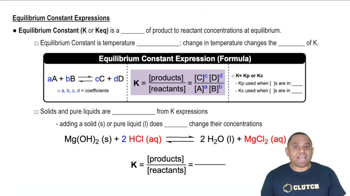
Equilibrium Constant (Kc)

The equilibrium constant, denoted as Kc, quantifies the ratio of the concentrations of products to reactants at equilibrium for a reversible reaction. For the reaction given, Kc = [Ca²⁺][SO₄²⁻] / [CaSO₄], where solid CaSO₄ does not appear in the expression. A small Kc value, like 2.4 × 10⁻⁵, indicates that at equilibrium, the concentration of products is much lower than that of the reactants, suggesting that the reaction favors the formation of solid CaSO₄.
Video consigliato:
Percorso guidato
03:20
Equilibrium Constant Expressions

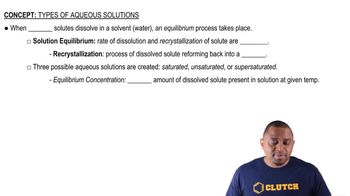
Saturated Solution

A saturated solution is one in which the maximum amount of solute has been dissolved in a solvent at a given temperature, resulting in a dynamic equilibrium between the dissolved ions and the undissolved solute. In this case, when excess CaSO₄ is added to water, it will dissolve until the solution reaches saturation, where the concentrations of Ca²⁺ and SO₄²⁻ ions remain constant, governed by the equilibrium constant.
Video consigliato:
Percorso guidato
01:11
Types of Aqueous Solutions

Stoichiometry and Mass Calculations

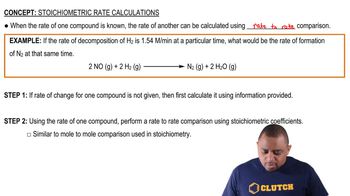
Stoichiometry involves using the relationships between reactants and products in a chemical reaction to calculate quantities. In this scenario, once the equilibrium concentrations of Ca²⁺ and SO₄²⁻ are determined, the molarity can be converted to moles, and then to mass using the molar mass of CaSO₄. This allows for the calculation of the minimum mass of CaSO₄ needed to achieve the desired equilibrium concentrations in a specified volume of solution.
Video consigliato:
Percorso guidato
02:28
Stoichiometric Rate Calculations
Pratica correlata
Domanda del libro di testo

For the equilibrium Br2(𝑔) + Cl2(𝑔) ⇌ 2 BrCl(𝑔) at 400 K, 𝐾𝑐 = 7.0. If 0.25 mol of Br2 and 0.55 mol of Cl2 are introduced into a 3.0-L container at 400 K, what will be the equilibrium concentrations of Br2, Cl2, and BrCl?

1290
views
1
rank
Domanda del libro di testo

At 80°C, 𝐾𝑐 = 1.87×10⁻³ for the reaction PH3BCl3(𝑠) ⇌ PH3(𝑔) + BCl3(𝑔) (a) Calculate the equilibrium concentrations of PH3 and BCl3 if a solid sample of PH3BCl3 is placed in a closed vessel at 80°C and decomposes until equilibrium is reached.

496
views
Domanda del libro di testo

At 80°C, 𝐾𝑐 = 1.87×10⁻³ for the reaction PH3BCl3(𝑠) ⇌ PH3(𝑔) + BCl3(𝑔) (a) Calculate the equilibrium concentrations of PH3 and BCl3 if a solid sample of PH3BCl3 is placed in a closed vessel at 80°C and decomposes until equilibrium is reached. (b) If the flask has a volume of 0.250 L, what is the minimum mass of PH3BCl3(𝑠) that must be added to the flask to achieve equilibrium?

302
views
1
rank
Domanda del libro di testo

At 2000°C, the equilibrium constant for the reaction 2 NO(𝑔) ⇌ N2(𝑔) + O2(𝑔) is 𝐾𝑐 = 2.4×10³. If the initial concentration of NO is 0.175 M, what are the equilibrium concentrations of NO, N2, and O2?

983
views
Domanda del libro di testo

At 25°C, the reaction CaCrO4(𝑠) ⇌ Ca2+(𝑎𝑞) + CrO42−(𝑎𝑞) has an equilibrium constant 𝐾𝑐 = 7.1×10⁻⁴. What are the equilibrium concentrations of Ca2+ and CrO42− in a saturated solution of CaCrO4?

398
views