For a certain chemical reaction, ΔH° = -35.4 kJ and ΔS° = -85.5 J/K. (b) Does the reaction lead to an increase or decrease in the randomness or disorder of the system?
Ch.19 - Chemical Thermodynamics

Brown15th EditionChemistry: The Central ScienceISBN: 9780137542970Non è quello che usi tu?Cambia libro di testo
Capitolo 19, Problema 54
(a) Is the standard free-energy change, ΔG°, always larger than ΔG? (b) For any process that occurs at constant temperature and pressure, what is the significance of ΔG = 0? (c) For a certain process, ΔG is large and negative. Does this mean that the process necessarily has a low activation barrier?
Guida verificata passo dopo passo1
Step 1: Understand the relationship between ΔG° and ΔG. ΔG° is the standard free-energy change, which is measured under standard conditions (1 atm, 298 K, 1 M concentrations). ΔG is the free-energy change under any set of conditions. The relationship between them is given by the equation ΔG = ΔG° + RT ln(Q), where R is the gas constant, T is the temperature in Kelvin, and Q is the reaction quotient.
Step 2: Analyze the condition ΔG = 0. When ΔG = 0, the system is at equilibrium. This means that the forward and reverse reactions occur at the same rate, and there is no net change in the concentrations of reactants and products over time.
Step 3: Consider the implications of a large negative ΔG. A large negative ΔG indicates that the process is spontaneous and releases a significant amount of free energy. However, this does not necessarily imply a low activation barrier. The activation energy is a separate factor that determines the rate of the reaction, not its spontaneity.
Step 4: Differentiate between thermodynamics and kinetics. Thermodynamics, which involves ΔG, tells us about the favorability and extent of a reaction, while kinetics, which involves activation energy, tells us about the speed of the reaction. A reaction can be thermodynamically favorable (large negative ΔG) but kinetically slow if it has a high activation barrier.
Step 5: Summarize the key points. ΔG° is not always larger than ΔG; it depends on the conditions and the value of Q. ΔG = 0 signifies equilibrium. A large negative ΔG indicates spontaneity but does not guarantee a low activation barrier, as kinetics and thermodynamics are distinct concepts.
Concetti chiave
Ecco i concetti essenziali che devi comprendere per rispondere correttamente alla domanda.
Standard Free Energy Change (ΔG°)
The standard free energy change, ΔG°, is the change in free energy under standard conditions (1 M concentration, 1 atm pressure, and a specified temperature, usually 25°C). It indicates the spontaneity of a reaction; a negative ΔG° suggests that the reaction is spontaneous under standard conditions, while a positive ΔG° indicates non-spontaneity.
Video consigliato:
Percorso guidato
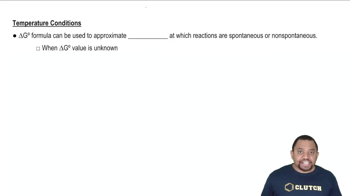
Standard Gibbs Free Energy and Temperature
Gibbs Free Energy (ΔG)
Gibbs free energy, ΔG, represents the change in free energy for a process at any given set of conditions. It accounts for the actual concentrations of reactants and products, and it determines whether a reaction is spontaneous at those conditions. A negative ΔG indicates spontaneity, while a positive ΔG indicates that the reaction is non-spontaneous.
Video consigliato:
Percorso guidato
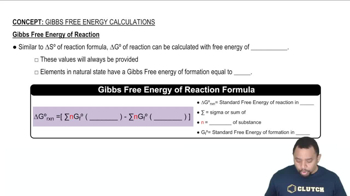
Gibbs Free Energy of Reactions
Activation Energy and Reaction Rate
Activation energy is the minimum energy required for a reaction to occur. A large and negative ΔG indicates that a reaction is thermodynamically favorable, but it does not necessarily correlate with a low activation barrier. The activation barrier can still be high, meaning that even favorable reactions may proceed slowly if the energy required to initiate them is significant.
Video consigliato:
Percorso guidato
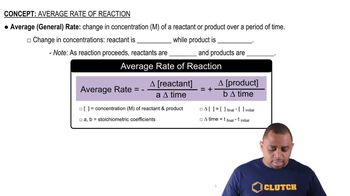
Average Rate of Reaction
Pratica correlata
Domanda del libro di testo
647
views
Domanda del libro di testo
(a) For a process that occurs at constant temperature, does the change in Gibbs free energy depend on changes in the enthalpy and entropy of the system?
869
views
Domanda del libro di testo
Using S° values from Appendix C, calculate ΔS° values for the following reactions. In each case, account for the sign of ΔS°.
(a) C2H4(g) + H2(g) → C2H6(g)
(b) N2O4(g) → 2 NO2(g)
(c) Be(OH)2(s) → BeO(s) + H2O(g)
(d) 2 CH3OH(g) + 3 O2(g) ⟶ 2 CO2(g) + 4 H2O(g)
1507
views
Domanda del libro di testo
For a certain chemical reaction, ΔH° = -35.4 kJ and ΔS° = -85.5 J/K. (c) Calculate ΔG° for the reaction at 298 K. (d) Is the reaction spontaneous at 298 K under standard conditions?
1
views
Domanda del libro di testo
(b) For a certain process that occurs at constant T and P, the value of ΔG is positive. Is the process spontaneous?