Ch.5 - Periodicity & Electronic Structure of Atoms
McMurry - Chemistry 8th Edition
McMurry8th EditionChemistryISBN: 9781292336145Non è quello che usi tu?Cambia libro di testo
Capitolo 5, Problema 119

Why do atomic radii decrease from left to right across a period of the periodic table?

Guida verificata passo dopo passo
1
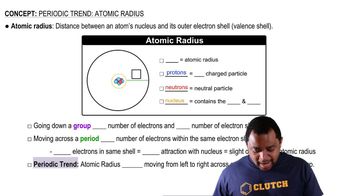
Atomic radii refer to the size of an atom, typically measured from the nucleus to the outermost electron shell.
As you move from left to right across a period in the periodic table, the number of protons in the nucleus increases.
This increase in protons results in a greater positive charge in the nucleus, which attracts the negatively charged electrons more strongly.
The increased nuclear charge pulls the electron cloud closer to the nucleus, reducing the size of the atom.
Therefore, the atomic radii decrease from left to right across a period due to the increased effective nuclear charge.

Risposta video verificata per un problema simile:

Questa soluzione video è stata consigliata dai nostri tutor come utile per risolvere questo problema.
Durata del video:
2m

Concetti chiave

Ecco i concetti essenziali che devi comprendere per rispondere correttamente alla domanda.

Atomic Radius

Atomic radius refers to the distance from the nucleus of an atom to the outermost shell of electrons. It is a measure of the size of an atom and can vary based on the atom's position in the periodic table.
Video consigliato:

Effective Nuclear Charge

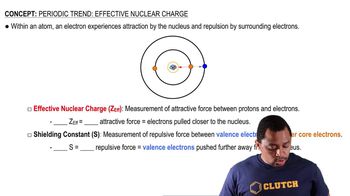
Effective nuclear charge is the net positive charge experienced by an electron in a multi-electron atom. As you move from left to right across a period, the number of protons increases, leading to a higher effective nuclear charge, which pulls electrons closer to the nucleus.
Video consigliato:
Percorso guidato
01:51
Effective Nuclear Charge

Electron Shielding

Electron shielding occurs when inner-shell electrons partially block the attraction between the nucleus and the outer-shell electrons. As you move across a period, the increase in protons is not significantly countered by shielding, resulting in a stronger attraction and a decrease in atomic radius.
Video consigliato:
Percorso guidato
04:44
Electron Geometry